
beginner
Rukmini Devi Arundale: How One Dancer Reshaped Bharatanatyam
Who was Rukmini Devi Arundale, what did she change in Bharatanatyam, and why do her choices still shape the way students stand, dress and perform today? A guru's view.
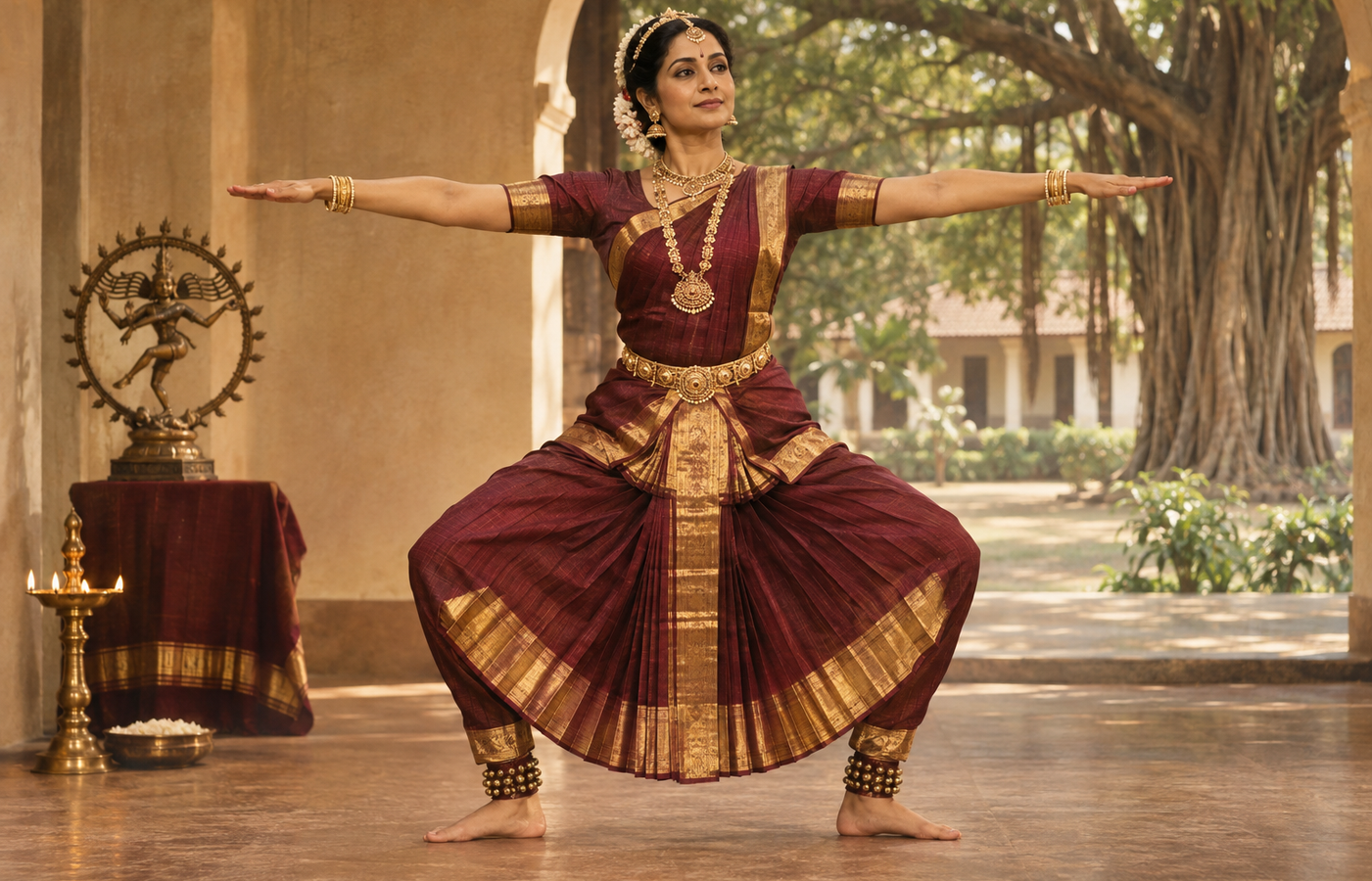
Every student who walks into class, settles into aramandi and lifts the arms into a clean line is carrying a little of Rukmini Devi Arundale with them. She did not invent Bharatanatyam, and she was not born into its hereditary lineage. Yet the stage, the costume, the order of a recital and the very idea of a dance school as we know it all bear her stamp. Here is who she was, what she changed, and what that means for your practice.
Key Takeaways
- Rukmini Devi Arundale (1904 to 1986) began serious study of the dance in her late twenties and gave her first public performance in 1935.
- In 1936 she founded Kalakshetra in Adyar, Chennai, which turned a family-taught art into a structured school curriculum.
- She reshaped the stage presentation of the dance: costume, jewellery, staging, music and large dance-dramas.
- Her reforms are honoured and also questioned, because the hereditary devadasi and nattuvanar families who kept the art alive were pushed to the margins.
- The clean lines, deep aramandi and disciplined geometry many students learn today trace directly to the Kalakshetra approach.
Who Was Rukmini Devi Arundale?
Rukmini Devi was born on 29 February 1904 in Madurai, Tamil Nadu, into a Brahmin family. Her father was drawn to the Theosophical Society, and the family settled near its headquarters at Adyar in Madras, now Chennai. That world of lectures, travel and international ideas shaped her far more than any dance hall did in her early years.
In 1920, at sixteen, she married George Arundale, an English Theosophist who later became president of the Society. The marriage across race and age caused real scandal in Madras society at the time. It also gave her a life of travel, an audience among artists abroad, and the confidence to step outside what was expected of a young woman of her background.
The turn toward dance
Her first serious encounter with dance was ballet. She met the Russian ballerina Anna Pavlova, who encouraged her to look to the dance of her own country, and she took ballet lessons from Cleo Nordi of Pavlova's company. Then in 1933 she watched a performance of sadir, the temple and court dance of Tamil Nadu, at the Madras Music Academy. She decided this was the art she wanted to give her life to.
She studied first with Mylapore Gowri Ammal, a devadasi dancer, and then with the nattuvanar Pandanallur Meenakshisundaram Pillai, a master of one of the most respected lineages. She was around thirty, an age at which most dancers of that era had long finished training. In 1935 she performed publicly for the first time, at the Diamond Jubilee convention of the Theosophical Society in Adyar.
Kalakshetra: Rukmini Devi Arundale's School
In January 1936, with George Arundale, she founded the International Academy of the Arts at Adyar. It soon became known as Kalakshetra, meaning a sacred place of the arts. Until then, Bharatanatyam was learned inside families: a nattuvanar taught a small number of students, often from hereditary dancing communities, in his own home and his own way.
Kalakshetra changed the unit of teaching from the household to the institution. Students lived and studied on campus, learned music, Sanskrit and Tamil literature alongside dance, and followed a set syllabus. The academy brought together dancers, nattuvanars and some of the finest Carnatic musicians of the time, and it trained generations of teachers who carried its method across India and then across the world.
Kalakshetra took the guru-shishya parampara and gave it walls, a timetable and a syllabus, while keeping the guru at the centre.
Parliament later declared the Kalakshetra Foundation an institution of national importance in 1993. Its graduates are one reason so many diaspora families today, from Chennai to Lexington, Kentucky, can find a trained teacher at all.
What She Changed on the Stage
Rukmini Devi's influence is easiest to see in how a performance looks. Several features that now feel timeless were shaped, or strongly standardised, at Kalakshetra.
Line and geometry
The Kalakshetra style is known for crisp, straight lines, a deep and steady aramandi, and arms held in precise planes. Movement is clean and economical, with little ornament in the body between positions. You can read more about how this compares with other lineages in our guide to Bharatanatyam banis and styles.
Costume, jewellery and stagecraft
She worked on a stitched costume suited to a proscenium stage, with a pleated fan that opens in aramandi, and promoted the temple-style jewellery now worn across the form. She paid attention to lighting, backdrop and the arrangement of the orchestra, and an image of Nataraja on stage became common practice. Our guides to the Bharatanatyam costume and traditional jewellery explain what each piece is for.
Repertoire and dance-drama
She choreographed large group dance-dramas, including Kutrala Kuravanji and a celebrated series drawn from the Ramayana. These works brought Sanskrit and Tamil literature to the stage with many dancers at once, a scale that solo recital never attempted. In solo repertoire, she reframed many shringara (love) themes as devotion, and some compositions she considered unsuitable for the stage were set aside.
The Debate Around the Revival
A guru owes her students the full story, and this part is not simple. Before the revival, the art was carried by devadasis, women dedicated to temple service, and by the nattuvanar families who taught them. The anti-nautch campaigns of the early twentieth century attacked the devadasi system, and the Madras Devadasis (Prevention of Dedication) Act of 1947 ended temple dedication.
Supporters credit Rukmini Devi, along with the lawyer and dancer E. Krishna Iyer, with saving a dance that was close to disappearing and making it respectable enough for families of every background to learn. Critics, including many scholars and descendants of hereditary dancers, argue that the revival moved the art away from the very community that preserved it, and recast its sensuality as something to be cleaned up.
The great dancer T. Balasaraswati, from a hereditary lineage, openly disagreed with the idea that shringara needed purifying, and defended the depth of the older abhinaya. Both streams are alive today. Our overview of Bharatanatyam as a traditional dance of India places this period in the longer story.
Beyond Dance: Public Life and Animal Welfare
Rukmini Devi was nominated to the Rajya Sabha, India's upper house of Parliament, in 1952 and served two terms. She was a committed vegetarian and a leading voice for animal welfare. She worked for the passage of the Prevention of Cruelty to Animals Act of 1960 and chaired the Animal Welfare Board of India.
She received the Padma Bhushan in 1956 and the Sangeet Natak Akademi Fellowship. In 1977 the Prime Minister, Morarji Desai, suggested her name for President of India; she declined, preferring to stay with her work at Kalakshetra. She died in Madras on 24 February 1986.
Seeing Her Legacy in Your Own Practice
History becomes useful when it changes how you dance. Here are five things to try this week, at home or before class.
- Check your line in a mirror. Hold natyarambhe for a slow count of eight. Are the arms level with the shoulders and the fingertips in one plane? That precision is the Kalakshetra ideal.
- Test your aramandi. Sit into it for three rounds of a slow tattadavu. Knees should open over the toes and the height should not rise between steps. Our guide to Bharatanatyam stances shows the correct position.
- Watch two styles side by side. Find a recorded Kalakshetra-trained dancer and a dancer from a hereditary lineage performing a padam. Note where one is geometric and the other more fluid.
- Learn one item's story. Before you practise a piece from the margam, find out who composed it and what the lyrics mean.
- Ask your guru about her lineage. Every teacher sits somewhere in this history. Knowing where yours comes from tells you why she corrects what she corrects.
Learning Bharatanatyam With This History in Mind
At Sridevi Dance Academy we teach the discipline of line and structure that the revival made standard, and we teach the abhinaya and devotion that the older tradition guarded. Students learn the names, the meaning and the history behind each item, so they understand why the dance looks the way it does.
Classes run in person in Lexington, Kentucky and online for families across the diaspora. You can explore our Bharatanatyam classes or schedule a trial class to see how we teach.
Common questions
Who was Rukmini Devi Arundale?
Rukmini Devi Arundale (1904 to 1986) was a dancer, choreographer, Theosophist and animal welfare campaigner from Tamil Nadu. She is best known for leading the twentieth-century revival of Bharatanatyam and founding Kalakshetra in Chennai in 1936, which became one of the most influential dance schools in India.
What did Rukmini Devi Arundale change in Bharatanatyam?
She brought the dance onto the concert stage as a school-taught art. She shaped costume, jewellery and stage presentation, created large dance-dramas, emphasised clean lines and a deep aramandi, and reframed many love themes as devotion. She also built a structured curriculum at Kalakshetra in place of purely family-based teaching.
Who were Rukmini Devi's gurus?
She first studied with Mylapore Gowri Ammal, a dancer from the devadasi tradition, and then with the nattuvanar Pandanallur Meenakshisundaram Pillai, one of the most respected teachers of his time. She began this training around the age of thirty and gave her first public performance in 1935 at Adyar.
Why is Rukmini Devi's role in the revival debated?
Supporters say she saved a dying art and made it respectable for all families. Critics argue the revival sidelined the hereditary devadasi and nattuvanar communities who had preserved the dance, and toned down its sensual expression. Dancers such as T. Balasaraswati defended the older approach, and both views are worth understanding.
What is the Kalakshetra style of Bharatanatyam?
The Kalakshetra style, or bani, is known for precise geometric lines, a steady and deep aramandi, clear arm positions and an economical, disciplined quality of movement. It grew from Rukmini Devi's work at Kalakshetra and is taught widely around the world, including by many teachers trained in its method.
Can my child learn about Bharatanatyam history in class?
Yes. At Sridevi Dance Academy, history and meaning are taught alongside technique, so students know where each item and posture comes from. Classes are available in person in Lexington, Kentucky and online, and you can schedule a trial class through our contact page to see how we teach.