beginner
The Bharatanatyam Costume: What Every Piece Means
A guru's guide to the Bharatanatyam costume: every stitched piece, ornament, and marking explained, plus what a beginner actually needs to buy.
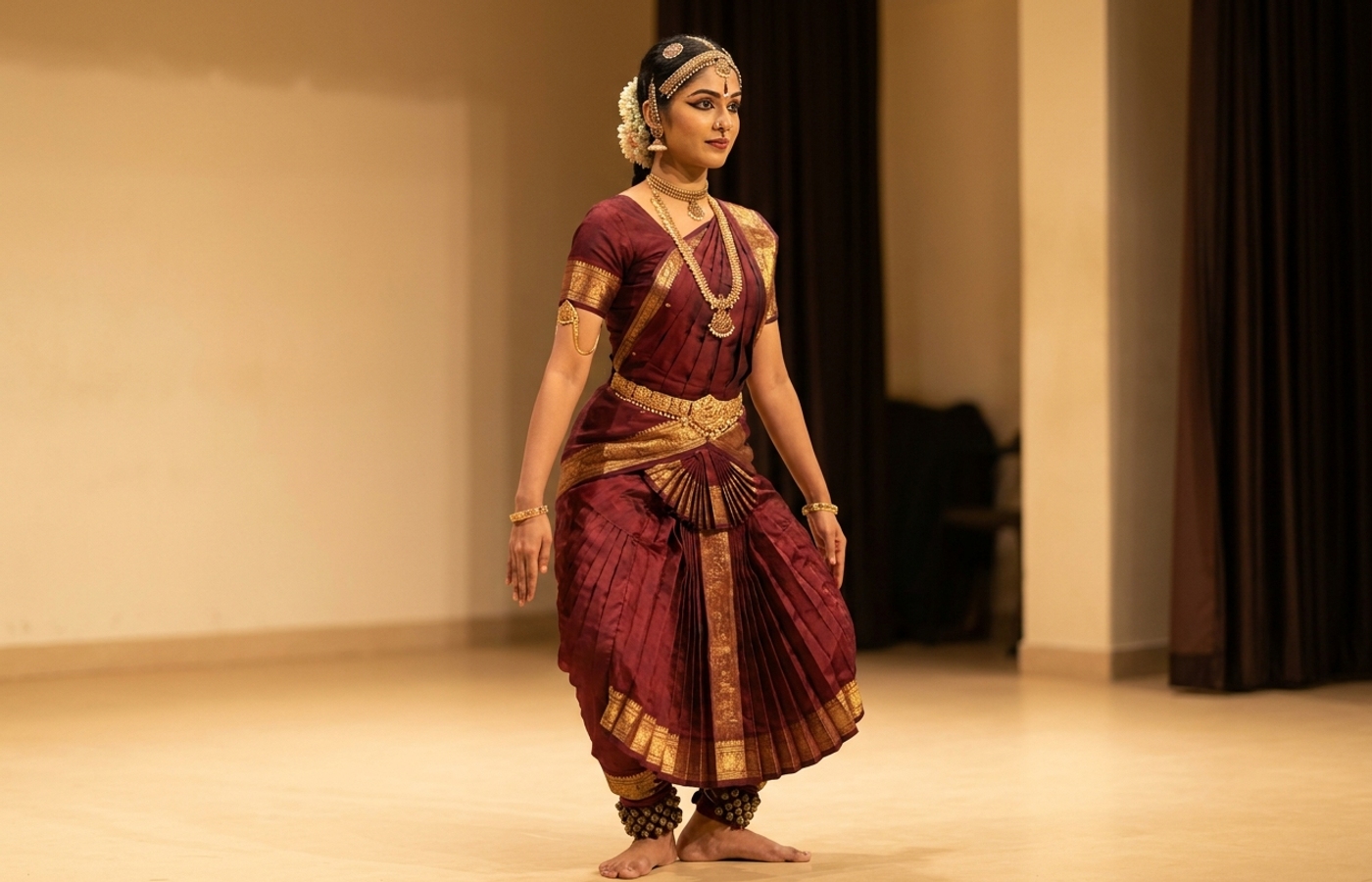
Search for a Bharatanatyam costume online and you will find price lists, fabric swatches, and size charts. What you will rarely find is an explanation of what you are actually buying. The costume is not a uniform and it is not decoration. In the grammar of our art it has a name, aharya abhinaya, and it carries meaning in the same way a hasta or a bhava does. Before a family in Lexington, Kentucky or a student joining us online spends anything on silk and jewellery, it is worth understanding what each piece is called, what it does, and when a student is ready for it.
The Bharatanatyam costume is one of the four abhinayas
The Natya Shastra describes four channels through which a dancer communicates. Angika abhinaya is expression through the body, its limbs, and its gestures. Vachika abhinaya is expression through speech, song, and the sung word the dancer interprets. Satvika abhinaya is the inner, felt emotion that makes the rest believable. Aharya abhinaya is everything worn and applied: costume, ornament, makeup, hair, and the setting of the stage itself.
Placing costume alongside gesture and emotion tells you how seriously the tradition takes it. A dancer who understands aharya treats the silk and the jewellery as instruments. Every element exists to make the body more legible to an audience sitting many rows back, and to place the dancer inside a visual language the audience already recognises.
Where the stitched costume came from
The costume most students wear today is not ancient in its stitched form. For centuries dancers performed in draped saris, managing the fabric with the skill that daily wear taught them. As Bharatanatyam moved from temple and court spaces onto the proscenium stage in the twentieth century, the attire was redesigned so that it would hold its shape through vigorous nritta and read clearly under stage lighting. Kalakshetra, founded by Rukmini Devi Arundale, was central to that rethinking. The result was a pleated, stitched garment that behaves predictably at speed while keeping the visual vocabulary of the draped sari.
Knowing this history matters for a student. It explains why the costume is engineered around the aramandi, the half sitting position that defines our stance work, and why the pleats open exactly where the knees turn out.
The two common styles: pyjama and skirt
The pyjama style, sometimes called the pant style, uses fitted trousers with a pleated fan sewn between the legs. When the dancer sits into aramandi or opens into a wide mandi position, that fan spreads and gives the audience a clean geometric shape. It is the more common choice for a full margam because it keeps the legs visible and does not restrict jumps or deep sitting.
The skirt style uses a long pleated skirt with a separate fan attached at the front. It reads as softer and more flowing, which suits abhinaya heavy repertoire and pieces where the dancer travels less. Many senior students own both and choose according to the item. Younger children are often started in the skirt style because it is more forgiving to fit as they grow.
Anatomy of the costume, piece by piece
A stitched Bharatanatyam costume usually arrives as a set of separate pieces rather than a single garment. The blouse is fitted and short sleeved, cut to allow full shoulder rotation for hasta work. The trousers or skirt form the base. The fan, the pleated panel that opens at the knees, is the signature element and is what most people picture when they think of the form.
A shoulder cloth crosses the torso and is pinned securely at the waist so it cannot shift during a jathi. A waist belt, the odiyanam, sits over the join and does real work: it holds the pleats in place and draws the eye to the centre of the body, which is where the audience reads balance and turnout from. Traditional costumes are cut from Kanchipuram or similar silk with a contrasting border in zari, because a strong border outlines the moving shape at a distance. There is no rule assigning meaning to particular colours. The practical logic is contrast, both between the body of the costume and its border, and between the dancer and the backdrop.
Temple jewellery and the name of every ornament
The jewellery worn for performance is called temple jewellery, traditionally made in gold or gold plated silver and now widely available in well made imitation sets. Learn the names, because your guru will use them.
On the head, the nethi chutti rests along the centre parting with a pendant at the forehead. The surya and chandra, sun and moon, are pinned on either side of the parting. The rakodi covers the hair bun. When the hair is braided, the jadai nagam runs down the length of the plait and finishes in kunjalam, the hanging tassels that catch the light when the head turns through shiro bheda. Fresh flowers, usually jasmine, are pinned around the bun or along the braid.
At the ears, jhimki style earrings hang free while mattal chains run from the earlobe up to the hair to take their weight. The neck carries two pieces: a close fitting choker such as an addigai or a kaasu malai of coin discs, and a longer chain that falls over the chest. The arms take a vanki, the armlet shaped to sit above the elbow, along with bangles. The odiyanam belts the waist. A nose ornament is worn by some dancers and not by others, and that is a family and lineage decision rather than a rule.
Makeup, alta, and why the face is painted for distance
Stage makeup in Bharatanatyam is not about glamour. It is about carrying expression to the back of the hall. The eyes are outlined heavily because drishti bheda, the movement of the glance, is a whole category of expression in our training. If the audience cannot see where the eyes travel, an entire layer of abhinaya is lost. Brows are defined for the same reason. A pottu sits at the centre of the forehead.
Alta, the red dye applied to the hands and feet, is the piece that most surprises new parents. The fingertips are coloured and an outline is drawn around the palms and the soles. This does for the hands and feet what eyeliner does for the eyes. A mudra held at arm's length and a foot striking the floor in a thattu adavu both become far easier to read when they are outlined in red.
Salangai: the bells a student earns
Salangai, also called ghungroo, are the ankle bells strapped to each foot. They are not an accessory. They make the footwork audible, so the dancer, the nattuvanar, and the audience can all hear whether the feet are landing exactly on the tala or drifting off it. The bells are stitched to a leather or cloth strap and the number varies from strap to strap, with heavier straps producing a fuller sound.
In most lineages a student does not simply buy salangai and wear them. They are given, often in a small ceremony called salangai pooja, once the guru judges that the student's adavus are clean enough that the sound will be honest rather than embarrassing. That timing is a teaching decision, not a shopping decision. Ask your guru before ordering.
What a beginner actually needs
New families often assume a full costume is required on day one. It is not, and buying early is usually wasted money because children grow and because the costume is fitted closely. For regular class a student needs practice wear: a practice sari or dhavani for older students, or leggings with a kurta and a practice sari tied at the waist for younger ones. The point of practice wear is that it teaches the student to manage cloth around the aramandi without the expense of silk.
Feet are always bare. There are no shoes in Bharatanatyam, because contact with the floor is part of the technique. Hair is tied back and out of the face from the first class, since the head and neck work of shiro bheda and griva bheda cannot be assessed through loose hair. A full stitched costume is commissioned when a student is preparing for the stage, and it is measured in the aramandi position rather than standing upright.
Choosing, fitting, and caring for a costume
Have the costume tailored rather than bought off a rack wherever possible, and give the tailor measurements taken while sitting in aramandi with the arms extended. A costume that fits standing will bind at the shoulders and hips the moment the dancer sits. Leave a little seam allowance for a growing child. Check that the fan opens fully and that the shoulder cloth can be pinned tightly enough to survive a jathi without slipping.
Silk should be aired after every performance and dry cleaned sparingly, since frequent cleaning dulls zari. Store the costume flat or loosely rolled rather than tightly folded along the same crease. Wrap jewellery in soft cloth and keep the pieces separated so plating does not scratch. Salangai should be dried thoroughly and the stitching checked before every performance, because a bell that comes loose on stage is both a distraction and a hazard.
How we approach costume at Sridevi Dance Academy
We teach costume the way we teach everything else, which is by explaining the reason before the routine. Students learn the names of the ornaments alongside the names of the adavus. They learn to pin their own shoulder cloth, to tie their own salangai, and to check their own fit, because a dancer who depends on someone else to dress her is not yet independent on stage.
Families train with us in person in Lexington, Kentucky, and diaspora families across the country and beyond train with us online. For our online students we walk parents through fittings and sourcing over video before an event, so nobody is guessing at measurements or buying the wrong style. If you are weighing up serious classical training for your child or returning to the art as an adult, the costume is worth understanding early. It tells you a great deal about how the form thinks.
Common questions
What is a Bharatanatyam costume called?
There is no single word for the whole outfit. In the tradition it falls under aharya abhinaya, which covers costume, ornament, makeup, and hair together. The individual pieces have their own names: the fan of pleats, the odiyanam or waist belt, the shoulder cloth, and the temple jewellery set. The two common cuts are the pyjama or pant style and the skirt style.
How much does a Bharatanatyam costume cost?
Prices vary widely by fabric, tailoring, and whether jewellery is included, so ask your guru for current local and online sources rather than relying on a fixed figure. Silk costs more than art silk, custom tailoring costs more than readymade, and real temple jewellery costs far more than good imitation sets. Most students start with imitation jewellery and a well fitted readymade or tailored costume.
Does a beginner need a full costume right away?
No. Beginners train in practice wear, which is a practice sari or dhavani for older students, or leggings and a kurta with a practice sari for younger children. A full stitched costume is commissioned when a student is preparing for a stage performance. Buying early usually means buying twice, because the costume is fitted closely and children grow.
Why do Bharatanatyam dancers put red dye on their hands and feet?
The red outlining, known as alta, makes the hands and feet readable from a distance. Bharatanatyam builds meaning through hastas and through precise footwork, and both become much clearer to an audience when the fingertips, palms, and soles are outlined. It serves the same purpose as the heavy eye makeup used to project drishti bheda.
When does a student get salangai?
When the guru decides the student's adavus are clean and steady enough for the bells to sound honest. In many lineages this is marked with a small ceremony called salangai pooja. It is a milestone earned through progress rather than a purchase made at will, so speak to your guru before ordering a pair.
Do the colours of a Bharatanatyam costume mean anything?
There is no fixed system assigning meaning to particular colours. The practical logic is contrast. A costume body and a border in contrasting shades outline the moving shape clearly, and the whole costume should read against the stage backdrop and lighting. Families often choose colours for the occasion or personal preference, and a guru will advise on what works on stage.