beginner
Bharatanatyam Poses: A Guru's Guide to the Essential Stances
Learn the essential Bharatanatyam poses: samapada, aramandi, and muzhumandi. A guru explains the alignment, meaning, and practice behind each stance.
Every student who walks into a Bharatanatyam class begins in the same place: standing still. Before the first adavu is taught, before the hands learn a single hasta, the body must learn how to hold itself. Bharatanatyam poses are not decorative shapes borrowed for photographs. They are the structural grammar of the entire art form, and every jathi, every varnam, and every moment of abhinaya rests on them. When the stance is correct, the dance has a foundation. When it is not, everything built on top of it wobbles.
In the guru-shishya parampara, these positions are taught slowly and corrected constantly, because they shape the dancer's body over years. This guide walks through the essential stances the way we teach them at Sridevi Dance Academy: what each position is, how the body should be aligned, what it demands from the muscles, and why it matters. Whether you are a parent watching your child's first class or an adult beginner returning to the art, understanding these poses will change how you see every performance.
Why Bharatanatyam Poses Come Before Everything Else
Bharatanatyam is often described through its most visible elements: the expressive eyes, the sculptural hand gestures, the rhythmic footwork. But underneath all of it sits a small vocabulary of body positions that the tradition treats as non-negotiable. The Natya Shastra, the ancient treatise on performance, describes the body in precise terms, and the practical tradition that descends from it organizes the dancer's training around a few fundamental stances.
There is a reason gurus spend months on positions that look simple. The stances train three things at once. First, alignment: the spine, hips, knees, and feet learn a set of relationships that keep the body stable and safe. Second, strength: holding aramandi correctly for even a few minutes builds the thighs, hips, and back in a way that ordinary exercise does not replicate. Third, discipline: a student who can hold a stance patiently, accept correction, and refine a half-inch of turnout has learned how to learn. That habit carries into every later stage of the curriculum, from the first adavus to arangetram preparation.
Samapada: The Neutral Standing Position
Samapada is the simplest of the stances and the one from which the others are measured. The word combines sama, meaning equal or level, with pada, meaning foot. The dancer stands with feet together, weight distributed evenly, spine tall, shoulders relaxed and level, and chin parallel to the floor. The arms typically rest at the sides or on the hips depending on the exercise.
It looks like ordinary standing, but it is not. Most of us stand with our weight sunk into one hip, shoulders rounded, head drifting forward. Samapada asks for active stillness: the crown of the head reaching upward, the core gently engaged, the feet pressing evenly into the floor. In class, we return to samapada between exercises, and it becomes a physical reset. Students learn to feel the difference between casual standing and dancerly standing, and that awareness is the first real lesson in body control. Samapada also appears within choreography itself, in moments of repose, in devotional postures, and at the opening and closing of items.
Aramandi: The Half-Sitting Posture at the Heart of the Form
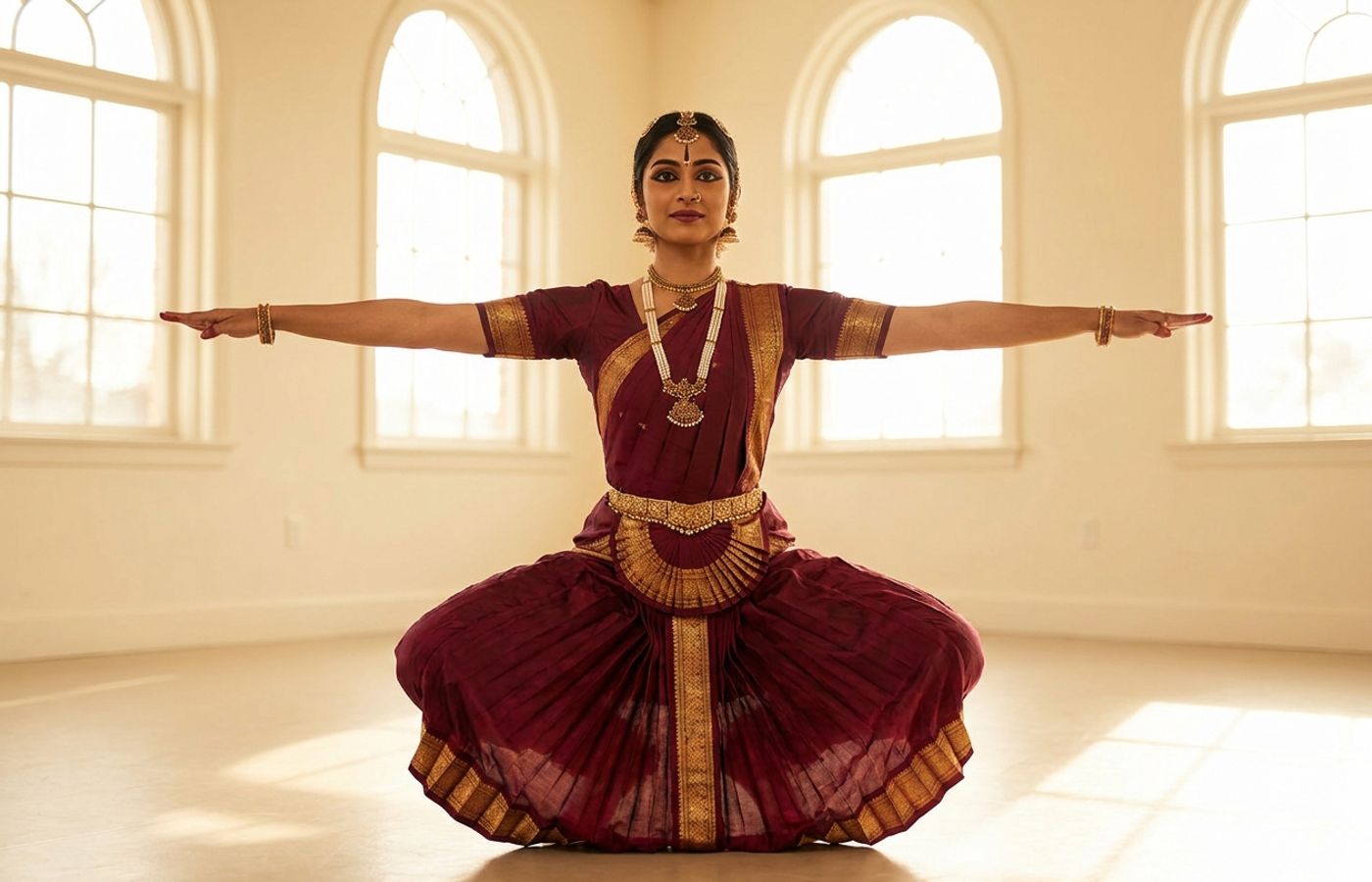
If Bharatanatyam has a signature, it is aramandi, also called araimandi or ardha mandala. This is the half-sitting position: heels together, feet turned outward so the toes point to the sides, knees bent and opening outward over the toes, hips lowered so the dancer sits roughly halfway between standing and a full squat. The back stays upright, the chest open, the head level. Seen from the front, the legs form the shape often compared to a diamond or the outline of a lamp.
Nearly every adavu is executed in aramandi. The rhythmic stamping of the feet, the crisp lines of the arms, the geometry that makes nritta so satisfying to watch, all of it happens in this half-seated frame. That is why gurus are famously exacting about it. Common corrections include knees collapsing inward instead of tracking over the toes, the seat pushing backward instead of lowering straight down, the back arching or leaning forward, and the heels drifting apart. Each error changes the geometry of the pose and, more importantly, shifts load onto joints that should not carry it.
Held correctly, aramandi is demanding and safe. The turnout comes from the hips, not the knees. The depth of the bend is built gradually over months, not forced in the first week. At our academy, this progression is treated with the same care a scientist brings to a protocol: the position is named, its checkpoints are defined, and students are corrected against those checkpoints every single class. Strength arrives on schedule when the method is consistent.
Muzhumandi: The Full-Sitting Position
Muzhumandi, also known as poorna mandala, is the full-sitting stance. From aramandi, the dancer descends all the way down until the hips rest near the heels, with the knees still turned outward and the heels raised so the dancer balances on the balls of the feet. The spine remains upright throughout. Muzhumandi appears in adavus of its own, in dramatic moments of choreography, and in sculpturesque poses that echo temple iconography.
The challenge of muzhumandi is control in both directions. Sinking into the position requires balance and ankle strength. Rising out of it smoothly, sometimes on a precise beat of the tala, requires real power in the thighs. Students meet muzhumandi early in the adavu syllabus, in the mandi adavus, and the position keeps reappearing at every level of the curriculum. A dancer who can move between samapada, aramandi, and muzhumandi with clean lines and quiet effort has mastered the vertical dimension of the form.
Natyarambham and the Positions of the Arms
The stances of the legs are completed by the carriage of the arms. The most fundamental arm position is natyarambham, which means the beginning of dance. In the common form taught first, the arms stretch out to the sides at shoulder level, elbows lifted and gently rounded, with the hands holding a hasta at the wrists. The line should look effortless, but maintaining lifted elbows while the legs hold aramandi is one of the first real tests of a student's stamina.
Around natyarambham, students learn the working vocabulary of arm placements that recur across adavus: hands at the chest, hands extended, one arm curved overhead while the other crosses the body. Combined with shiro bheda movements of the head, drishti bheda movements of the eyes, and griva bheda movements of the neck, these placements turn a static stance into a living pose. This is where students begin to feel the difference between holding a shape and inhabiting it, the seed of what will later become abhinaya.
From Still Poses to Moving Adavus
Bharatanatyam poses are not an end in themselves. They are the frame through which movement passes. An adavu is, in essence, a journey between positions: the body starts in aramandi, the feet strike the floor in a set rhythm, the arms travel between defined placements, and the sequence resolves back into a stance. Because the start and end points are precise, the movement between them can be precise too. This is why dancers trained with strict attention to stance look sharp even in fast jathis, while dancers with vague stances blur.
In a structured curriculum, this relationship is made explicit. Students first hold the pose, then move through the pose, then forget the pose because it has become part of them. By the time a dancer reaches varnam, the body returns to correct aramandi automatically, leaving the mind free for rhythm, expression, and storytelling. That freedom is the entire point of the early discipline.
Practicing Safely at Home and in Class
Students often ask how much stance practice they should do at home. The honest answer is: careful practice helps, and careless practice harms. A few principles keep home practice productive. Warm up before holding aramandi; a cold body should not sit into deep turnout. Practice in front of a mirror or record yourself, and check the same points your guru checks: heels together, knees over toes, back upright, shoulders level. Hold positions for short, repeated intervals rather than long painful ones. If the knees ache, stop and review the alignment, because correctly executed aramandi loads the muscles of the thighs and hips, not the knee joint.
Above all, home practice should reinforce what has been corrected in class, not invent new habits. This is one of the reasons regular classes with a guru matter so much in this art form. At Sridevi Dance Academy, students train in person in Lexington, Kentucky, and online with diaspora families across the United States and beyond, and both formats center on the same live correction of stance and alignment. A camera angle that shows the full body, a clear floor, and an unhurried pace make online stance work genuinely effective.
How a Guru Builds the Stances Over Years
Parents sometimes worry when a child spends the first months of training on what looks like a handful of positions and steps. This is not slowness; it is sequence. The traditional method builds the body before it decorates the movement. First samapada teaches posture. Then aramandi is introduced at a shallow depth and gradually deepened as the hips and thighs strengthen. Muzhumandi follows when the student can control the descent. The arms are added, then the head, neck, and eye movements, and only then do the composite adavus begin to accumulate speed.
Each season, students who have trained this way step onto the stage looking grounded and unhurried, because their bodies are not guessing. The stances have become home positions the body trusts. That is the quiet promise of guru-shishya parampara: nothing is skipped, everything is named and understood, and the result is a dancer who does not merely perform the form but carries it.
If you are ready to build this foundation, whether for your child or for yourself, we would be glad to welcome you into a batch. The stances are waiting, and they reward every hour given to them.
Common questions
What are the basic poses in Bharatanatyam?
The foundational positions are samapada, the equal standing posture; aramandi (araimandi), the half-sitting stance with turned-out knees; and muzhumandi (poorna mandala), the full-sitting position. These are completed by arm placements such as natyarambham and by head, neck, and eye movements known as shiro bheda, griva bheda, and drishti bheda.
Why is aramandi so important in Bharatanatyam?
Aramandi is the working stance of the form. Nearly all adavus are performed in this half-seated position, so its alignment determines the geometry, stability, and safety of everything the dancer does. Gurus correct it constantly because a strong aramandi makes every later stage of the curriculum cleaner and easier.
Is aramandi bad for the knees?
Correctly executed aramandi is safe. The turnout comes from the hips, the knees track over the toes, and the muscles of the thighs and hips carry the load rather than the knee joint. Problems arise from forcing depth too early or letting the knees collapse inward, which is why gradual, guru-supervised progression matters.
How long does it take to learn the Bharatanatyam stances?
Students learn the shape of the stances within their first weeks, but building the strength and habit to hold them correctly takes months of steady practice. Deepening aramandi and controlling muzhumandi continue to improve over years, alongside the rest of the curriculum from adavus to varnam.
Can adults learn Bharatanatyam poses, or is it only for children?
Adults absolutely can. The stances are built progressively for every body, and adult beginners often appreciate the structured, theory-backed method. Flexibility and depth develop with consistent practice at any age, provided the progression is patient and supervised.
Can I learn Bharatanatyam stances properly in online classes?
Yes, when the classes are live and correction-focused. With a camera angle showing the full body, an instructor can check heels, knees, spine, and shoulders just as in the studio. Sridevi Dance Academy teaches in person in Lexington, Kentucky and online for diaspora families, using the same stance checkpoints in both formats.