
intermediate
Nattuvangam: The Art of Conducting a Bharatanatyam Performance
What is nattuvangam? Learn how the nattuvanar conducts Bharatanatyam with sollukattu and cymbals, and why rhythm literacy makes students better dancers.
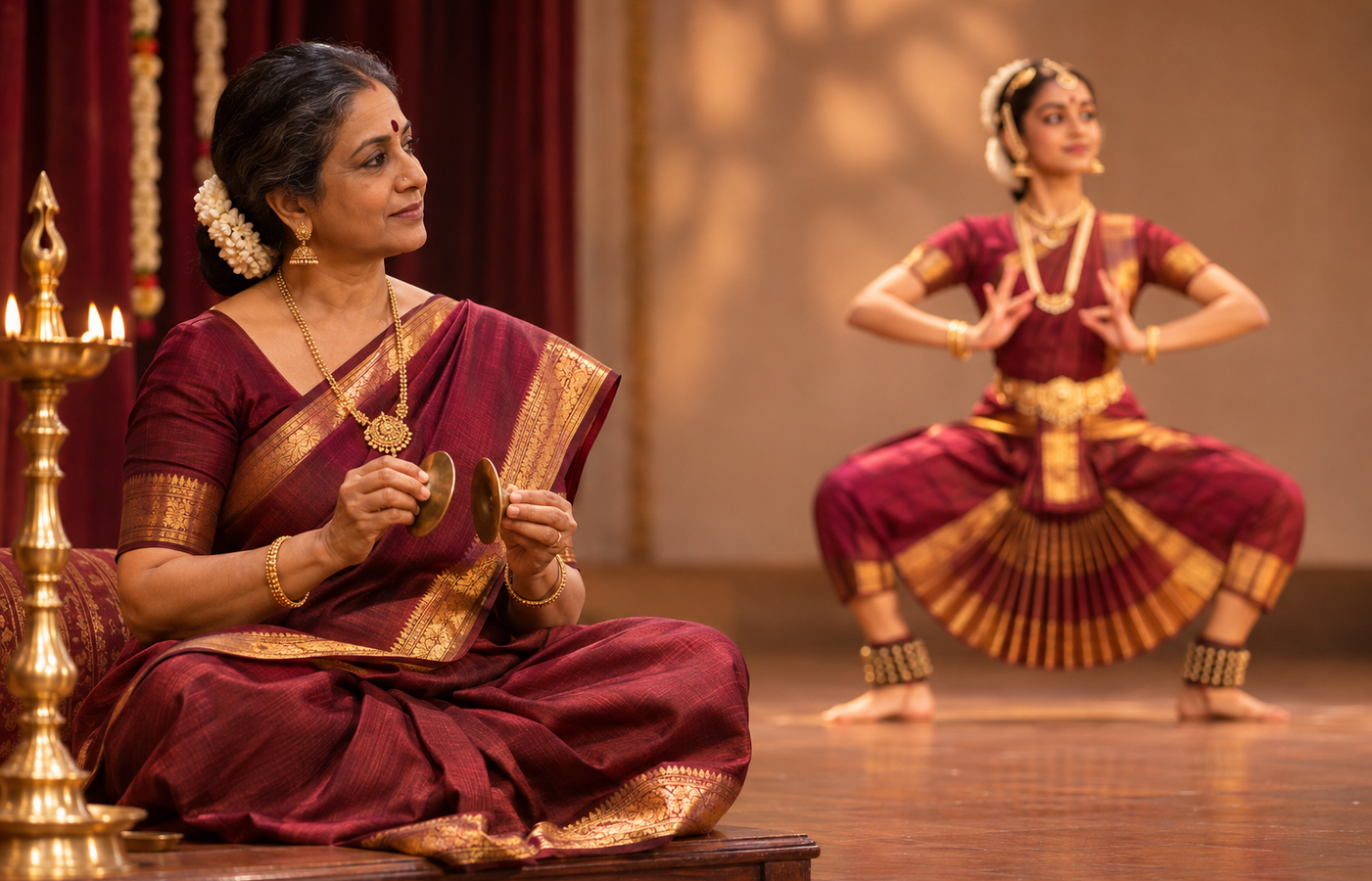
At every Bharatanatyam recital there is one person who never steps into the light yet shapes each second of the performance. Seated among the musicians with a pair of small cymbals, the guru speaks a stream of rhythmic syllables that the dancer's feet answer exactly. This is nattuvangam, the art of conducting Bharatanatyam, and understanding it changes how you watch a recital and how you practice at home.
Key Takeaways
- Nattuvangam is the conducting of a Bharatanatyam performance through recited rhythm and hand cymbals. The person who does it is the nattuvanar.
- It has two parts: sollukattu, the spoken syllables, and the talam, the cymbals that mark the rhythmic cycle.
- Traditionally the nattuvanar is the dancer's own guru, which is why the role is inseparable from teaching.
- Students who learn to recite their steps develop cleaner footwork, steadier timing, and stronger memory for choreography.
What Is Nattuvangam?
Nattuvangam is the practice of guiding a dance performance with the voice and a pair of small cymbals. In the Bharatanatyam orchestra the nattuvanar sits beside the vocalist, the mridangam player, and melodic accompanists such as violin, veena, or flute. The singer carries the melody and the mridangam carries the percussion, but it is the nattuvanar who holds the whole ensemble to the dancer.
The role is often compared to a conductor's, with one important difference. A conductor interprets a score written by someone else. The nattuvanar usually taught the dancer every movement being performed, and in many cases composed the rhythmic passages as well. The person who built each adavu into the student's body is the one who calls it out on stage.
The Nattuvanar: Guru, Composer, and Conductor
Bharatanatyam was not historically learned from books. It passed from teacher to student, in person, over many years, in what we call guru-shishya parampara. The nattuvanar carried the repertoire in memory and transmitted it through recitation, demonstration, and correction. Teaching, composing, and conducting were one profession.
The concert sequence most students learn today, the margam, is widely credited to the Thanjavur Quartet: the brothers Chinnayya, Ponnayya, Sivanandam, and Vadivelu, musicians and dance masters at the Thanjavur court in the early nineteenth century. The families of nattuvanars who followed them shaped the distinct lineages, or banis, that we recognize now. Each bani has its own way of reciting jathis and playing the cymbals, and a trained ear can often identify a lineage from the conducting alone.
Sollukattu and Jathis: The Spoken Language of Rhythm
Sollukattu are the rhythmic syllables of Bharatanatyam. Sounds such as tha, dhi, thom, nam, and tha ka dhi mi are not arbitrary. Each pattern has a fixed count and a particular weight, and each corresponds to a way the foot meets the floor.
Every beginner meets them on the first day. The opening tatta adavu is practiced to thai ya thai hi, and each family of adavus that follows is learned with its own syllables. When a student can speak the sollukattu of a step while dancing it, the step is no longer something copied from the teacher. It is understood from the inside.
How a jathi lands
In performance the nattuvanar recites longer compositions called jathis, rhythmic phrases built from sollukattu. Most end in a teermanam, a closing pattern repeated three times so that its last syllable falls exactly on the first beat of the cycle, the samam. A classic example is the five-syllable phrase:
tha dhi ghi na thom, tha dhi ghi na thom, tha dhi ghi na thom
When the dancer's final stamp, the mridangam's stroke, and the cymbal all arrive on that beat together, the audience feels it physically. That shared arrival looks effortless. It is the result of years of counting aloud.
The Talam and the Thattukazhi
The instrument of nattuvangam is a pair of small cymbals called the talam, traditionally made of bronze or brass. One is held steady while the other strikes it, producing a bright, precise ring. Good playing is never loud. It is clean and exactly placed, so the sound supports the footwork instead of competing with it.
In the classroom many teachers keep time with a wooden stick, the thattukazhi, struck on a wooden block. Generations of dancers learned their adavus to that sound. The stick suits daily teaching because the guru can keep rhythm with one hand and correct a posture with the other, while the cymbals are reserved for performance and rehearsals with musicians.
What the Nattuvanar Holds Together
Every piece is set to a tala, a repeating rhythmic cycle, and the conductor tracks several layers of it at once:
- Tala: the cycle itself. Adi tala, the most common, has eight beats. Rupaka, Misra Chapu, and Khanda Chapu are also frequent in the repertoire.
- Nadai: how each beat is subdivided, in groups of three (tisram), four (chatusram), five (khandam), seven (misram), or nine (sankeernam).
- Kalam: the speed. Adavus are learned in three speeds, each doubling the density of steps against the same pulse.
- Cues: entries for the singer, endings for the mridangam, and small adjustments when a dancer or musician drifts.
Doing all of this in real time requires a clear voice, a trained ear, and complete knowledge of the choreography. It is a discipline in its own right, and senior dancers often study it for years before conducting their own students.
Where You Hear Nattuvangam in the Margam
The conductor is most prominent in nritta, the passages of pure dance where rhythm and line are the subject.
- Alarippu: danced entirely to recited syllables with no lyrics, so the nattuvanar's voice leads from the first beat.
- Jathiswaram: an opening jathi followed by passages of melody set to adavu sequences.
- Varnam: the centerpiece, alternating expressive abhinaya with demanding jathis. Here the shift between song and recitation is easiest to hear.
- Thillana: the brisk closing piece, full of sculpted poses and crisp rhythmic endings.
In a padam and other expressive pieces the cymbals soften or fall nearly silent, supporting the bhava instead of driving the rhythm. A well-conducted recital feels seamless, and many audience members never consciously notice the nattuvanar at all.
Why Rhythm Literacy Makes Better Dancers
Most students will never conduct a full performance, and early training does not ask them to. Every serious student still benefits from reciting sollukattu and keeping tala with the hands. A dancer who can speak the rhythm practices more effectively alone, because she can tell whether a step is correct without waiting for a recording or a teacher.
At Sridevi Dance Academy theory is taught alongside technique for this reason. Students learn the name and syllables of each adavu, identify the tala they are dancing in, and recite a jathi before they dance it. Our founder and guru, Sridevi Thyagarajan, brings the precision of her scientific career to this work: every count is named and every landing is checked. The method holds in person in Lexington, Kentucky and in our online classes for diaspora families, where clear recitation matters even more because teacher and student are not in the same room.
For a student preparing for an arangetram, this understanding is part of stage readiness. A dancer who knows what the conductor is saying can respond to live musicians and recover calmly if something shifts.
A Ten-Minute Home Practice for Students and Parents
- Clap the cycle. Count Adi tala aloud, one through eight, clapping on each beat until the pulse is even.
- Speak before you step. Recite the sollukattu of one adavu in first speed while clapping. Keep the syllables crisp.
- Add the feet. Dance the adavu while reciting. If voice and feet separate, slow down.
- Double it. Move to second speed only when first speed stays together for four full cycles.
- Listen once a week. Watch a recital, find the nattuvanar, and try to feel each teermanam arrive on the samam.
Parents do not need dance training to help with the first two steps. Counting and clapping beside a child for a few minutes is often enough to steady the practice.
Nattuvangam is where rhythm, memory, and teaching meet, and it connects every lesson to the lineage of gurus who carried Bharatanatyam forward. If you would like your child, or yourself, to learn with this depth of understanding, explore our classes or schedule a trial class.
Common questions
What is nattuvangam in Bharatanatyam?
Nattuvangam is the art of conducting a Bharatanatyam performance. The conductor, called the nattuvanar, recites rhythmic syllables known as sollukattu and plays a pair of small cymbals to mark the tala, guiding both the dancer and the musicians.
Who is a nattuvanar?
A nattuvanar is the dance master who conducts the performance with cymbals and recitation. Traditionally the nattuvanar was also the teacher and composer, which is why a dancer's own guru usually performs nattuvangam at an arangetram.
What instrument is used for nattuvangam?
The nattuvanar plays a pair of small hand cymbals called the talam, traditionally made of bronze or brass. In daily classes many teachers instead keep rhythm with a wooden stick, the thattukazhi, struck on a wooden block.
What is the difference between sollukattu and a jathi?
Sollukattu are the individual rhythmic syllables, such as tha ka dhi mi. A jathi is a longer rhythmic composition built from those syllables. It usually ends in a teermanam, a pattern repeated three times to land on the first beat of the tala cycle.
Do Bharatanatyam students need to learn nattuvangam?
Students are not expected to conduct a performance, but reciting sollukattu and keeping tala with the hands is an essential part of serious training. It builds cleaner footwork, steadier timing, and stronger memory for choreography.
Can the rhythm side of Bharatanatyam be learned online?
Yes. Sridevi Dance Academy teaches in person in Lexington, Kentucky and online for diaspora families. Recitation of sollukattu and tala practice are built into every level, and clear spoken rhythm is especially helpful when teacher and student are in different rooms.