intermediate
Thillana in Bharatanatyam: The Margam's Closing Piece
A guru's guide to the thillana in Bharatanatyam: what it means, where it sits in the margam, its jati and sahitya structure, and how students prepare for it.
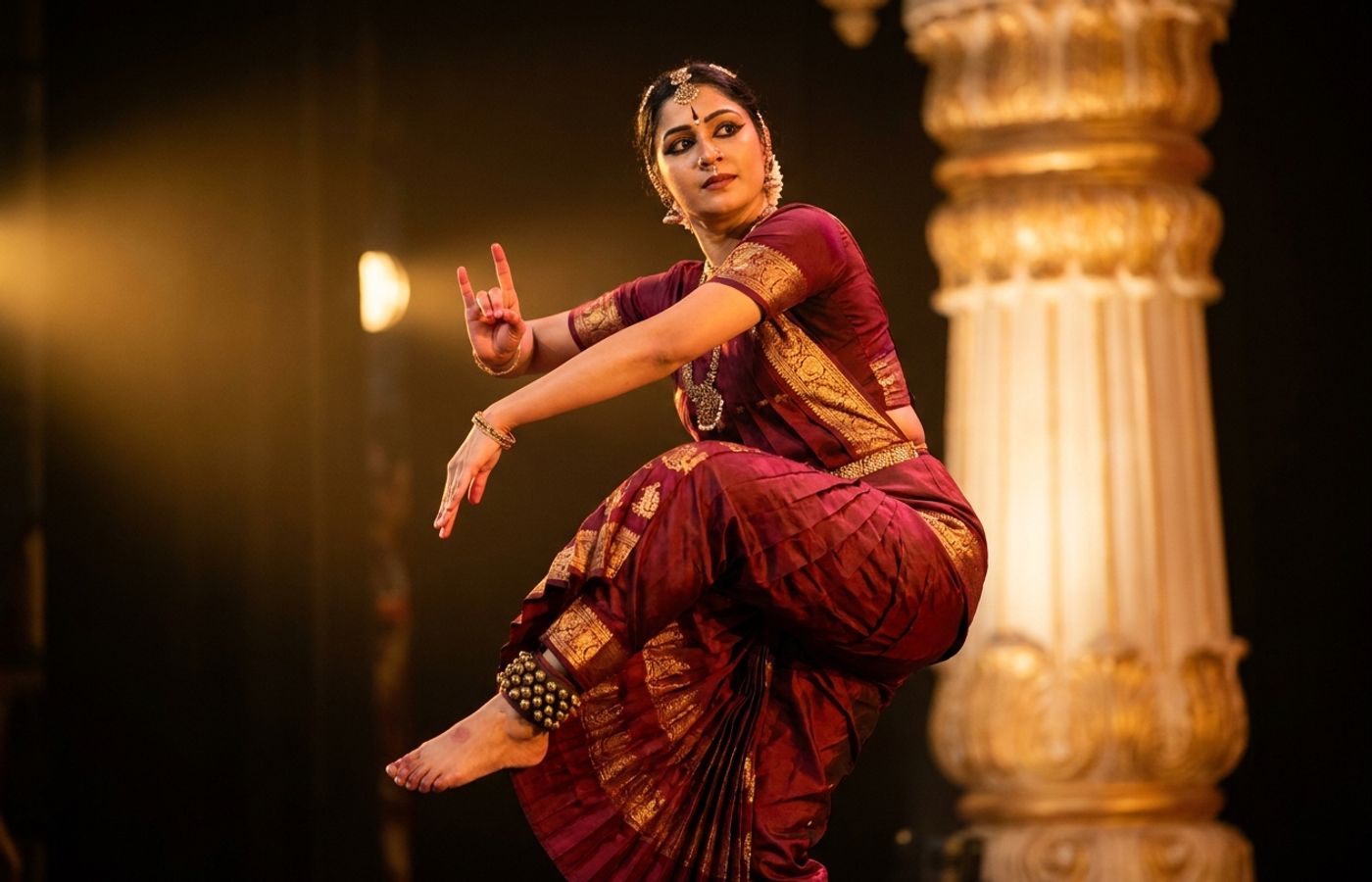
The thillana in Bharatanatyam is the piece that sends an audience home still hearing the rhythm. It arrives near the end of the margam, after the long technical and emotional labour of the varnam and the quiet interiority of the padams, and it asks something of the dancer that no earlier item does. It asks her to be purely, unapologetically rhythmic. No story to carry. No character to inhabit for ten minutes. Only line, speed, tala, and the discipline to make all three look effortless.
Search for thillana online and you will mostly find performance videos and lists of Carnatic music tracks. What is harder to find is a plain explanation of what the item is, why the tradition places it where it does, and what a student actually has to be able to do before a guru will teach one. That is what this article is for.
What the Thillana in Bharatanatyam Actually Is
A thillana, also spelled tillana, is first a musical form. It is a rhythmic composition in Carnatic music built largely on solkattu, the mnemonic syllables borrowed from percussion. Phrases such as dhirana, thom tha na, and nadhir dhir dhir thana are not lyrics in any ordinary sense. They are drum language set to melody. The dancer's job is to make that drum language visible.
In North Indian music the closely related form is called the tarana, and the two share the same instinct: end a concert with something bright, fast, and structurally clean. Bharatanatyam inherited the thillana from the Carnatic concert stage and gave it a body.
Because the syllables carry rhythm rather than meaning, the thillana is overwhelmingly nritta, pure dance. Abhinaya appears only briefly, in the short lyrical passage most thillanas contain. This is the reverse of the varnam, where meaning and expression dominate. Placing the two items in the same recital is deliberate. The margam is designed so that a dancer demonstrates every register of the form in a single sitting.
Where the Thillana Sits in the Margam
The margam, the traditional concert order, was codified in the nineteenth century by the Thanjavur Quartet: the brothers Chinnayya, Ponnayya, Sivanandam, and Vadivelu. Their sequence still shapes how a solo recital is built today.
It opens with the alarippu, a spare invocation that wakes the body from the fingertips outward. The jathiswaram follows, adding melody to rhythm without adding words. The shabdam introduces sahitya and the first sustained abhinaya. The varnam sits at the centre, the longest and most demanding item, holding both pure dance and expression in one architecture. After the varnam come the padams and javalis, slower pieces where the dancer works almost entirely in stillness and expression. Then the thillana. Then a short mangalam to close.
That placement is not accidental. By the time the thillana begins, the audience has been sitting inside emotional interiority for a long stretch. The thillana releases that tension. It also happens to be the hardest possible moment to dance fast, because the dancer has already been on stage for well over an hour. A thillana danced cleanly at the end of a full margam tells a guru more about a student's stamina and training than almost anything else in the programme.
The Musical Architecture: Jatis, Sahitya, Raga, and Tala
Most thillanas follow the standard Carnatic sectional layout: pallavi, anupallavi, and charanam. The pallavi and anupallavi are built from jati syllables. The charanam usually carries the sahitya, a short passage of actual words, and then the composition typically returns to the jatis to finish.
The sahitya is often a line in praise of a deity, and in older compositions sometimes in praise of a patron or a court. Swathi Thirunal's Dhanashree thillana is among the best known of the older pieces. From the twentieth century, the thillanas of Lalgudi Jayaraman, in ragas such as Behag, Desh, and Kaanada, and those of M. Balamuralikrishna, including the widely danced Brindavani and Kadanakuthuhalam thillanas, are staples of the stage.
Ragas favoured for thillanas tend to be bright and forward moving. Bilahari, Behag, Dhanashree, Kadanakuthuhalam, Hamsanandi, and Sindhu Bhairavi all appear frequently, and ragamalika thillanas that move through several ragas are common as well. Adi tala is the most usual rhythmic cycle, with rupakam and the chapu talas also in circulation. A student who has done the work on tala in the jathiswaram years will feel the difference immediately: the thillana does not give you time to count.
What the Body Does: Nritta at Full Voice
The thillana is where a dancer's adavu foundation is either visible or exposed. The vocabulary is not new. Tatta, natta, kudittametta, sarikkal, and the rest are the same adavus learned in the first years. What changes is speed, the density of korvai construction, and the demand that aramandi hold its depth from the first jati to the last.
Two features distinguish thillana choreography. The first is the sculpturesque pose. Thillanas are punctuated by held statuesque positions, often with one leg lifted or the torso in a deep diagonal, that echo the stone figures of temple sculpture. These poses are the item's signature and they are unforgiving. A pose is either landed and still or it is not, and an audience can see the difference from the back row.
The second is the interplay of stillness and burst. A thillana does not run at one continuous speed. It gathers, releases, arrives at a pose, holds a breath longer than feels comfortable, and then explodes into the next korvai. Students who treat the item as one long sprint miss what makes it beautiful.
The Sahitya: One Short Window of Abhinaya
When the sahitya arrives, usually in the charanam, the dancer shifts register completely. For a handful of lines the body slows, the hastas carry meaning rather than shape, and the face does the work. Then the jatis return and the shift reverses.
This transition is one of the most common places for a performance to lose its footing. A dancer running at full nritta speed has to arrive at the sahitya with a settled breath and a face that is not still recovering. We rehearse that hinge separately from the rest of the item, because it is a skill of its own.
How We Introduce the Thillana at Sridevi Dance Academy
We do not teach a thillana early. The item rewards a body that already has years of adavu discipline behind it, and it punishes one that does not. Before a student begins, we want to see a stable aramandi that does not rise under fatigue, clean nattuvangam response so the student can hold a korvai without being led, and enough tala literacy to feel a cycle rather than count it.
Typically that means a student has worked through alarippu and jathiswaram, has been introduced to the varnam, and is preparing towards a fuller programme. In our curriculum the thillana usually enters at the intermediate to advanced boundary, and always with the ending in view: it is a closing item, so it is taught as one.
We teach the jatis in fragments first, at half speed, with the solkattu recited aloud by the student before a single step is taken. A dancer who cannot say the rhythm will not dance it cleanly. Only once the syllables are secure in the mouth do we put them in the feet, and only after that do we add speed.
Five Corrections We Make Most Often
Rising out of aramandi. Speed tempts the knees upward. The half sitting position is the first thing to go and the last thing a dancer notices going. We film thillana rehearsals for exactly this reason.
Cutting the pose short. A sculpturesque pose held for three quarters of its beat reads as a stumble. The hold is part of the choreography, not a pause between the real material.
Loud landings. Thillana footwork is fast, and fast footwork invites heavy heels. A tatta adavu at speed should still sound like a decision, not a collapse.
Losing the arms. When the feet get difficult, hastas drift low and elbows soften. The upper body has to stay as disciplined as the lower one, especially in a piece the audience will remember visually.
Skipping the breath. Students hold their breath through hard korvais and then have nothing left for the sahitya. Breath is trained, not assumed.
Practising the Thillana Safely
A thillana is physically the most demanding sustained item most students will have attempted. Fast footwork in deep aramandi loads the knees, ankles, and lower back, and it usually comes at the end of a long practice when the body is already tired.
We insist on a proper warm up before any thillana work, on practising on a sprung or wooden surface rather than concrete or tile, and on breaking the item into sections rather than running it end to end repeatedly. Full runs have their place close to a performance, but they are not a daily training method. Students who are building stamina for a full margam add runs gradually, with rest days built in.
Learning the Thillana in Lexington and Online
At Sridevi Dance Academy in Lexington, Kentucky, thillana work happens in small groups and in one to one sessions, because the corrections are individual. We also teach diaspora families across the United States online, and the thillana translates surprisingly well to that format when the camera is placed correctly. What matters is a clear full body view, a hard floor surface, and a student who has already built the adavu foundation in earlier terms.
For families new to classical dance, the thillana is a useful thing to watch for at any recital. It is the item where training either holds or does not. If you are considering Bharatanatyam for your child or returning to it yourself, come and watch a class, and ask to see where the thillana sits in the curriculum.
Common questions
What does thillana mean in Bharatanatyam?
A thillana is a fast, rhythm led composition performed near the end of a Bharatanatyam margam. It is built mainly on solkattu, the mnemonic syllables of percussion, rather than on narrative lyrics, so it is almost entirely nritta or pure dance. Most thillanas contain one short sahitya passage with actual words, which gives the dancer a brief window of abhinaya before the rhythmic syllables return.
Is the thillana always the last item in a Bharatanatyam performance?
It is usually the last full item, but not quite the last thing danced. In the traditional margam the thillana is followed by a short mangalam, a concluding piece offering thanks and blessing. Some programmes vary the order for practical reasons, but the thillana keeps its place near the end because it is designed as a bright release after the emotional weight of the varnam and the padams.
What is the difference between a thillana and a tarana?
They are close cousins from two different music systems. The thillana belongs to Carnatic music in South India and the tarana to Hindustani music in the North. Both are built on rhythmic syllables rather than narrative text, and both traditionally close a concert. Bharatanatyam uses the thillana; Kathak dancers work with the tarana.
How long does it take to learn a thillana?
For a student with a settled adavu foundation, learning the choreography of a thillana typically takes several months of regular class work, and performing it cleanly at full speed at the end of a long programme takes considerably longer. The variable is rarely memory. It is stamina, the ability to hold aramandi under fatigue, and the confidence to land held poses without rushing them.
Which ragas are commonly used for a Bharatanatyam thillana?
Bright, forward moving ragas suit the form. Bilahari, Behag, Dhanashree, Kadanakuthuhalam, Hamsanandi, and Sindhu Bhairavi are all frequently danced, and ragamalika thillanas that travel through several ragas are common. Adi tala is the most usual rhythmic cycle, with rupakam and the chapu talas also in use.
Can adult beginners learn a thillana?
Yes, though not as an early item. Adults often progress through the foundations efficiently because they grasp the theory quickly, but the thillana still requires the same physical preparation as it does for younger students: a stable aramandi, secure adavus, and built up stamina. In our adult batches in Lexington and online we introduce it once that groundwork is genuinely in place, not before.