beginner
Tandava Dance in Bharatanatyam: Meaning, Forms, and Practice
What the tandava dance means, where it comes from, and how its force balances the grace of lasya inside everyday Bharatanatyam training and repertoire.
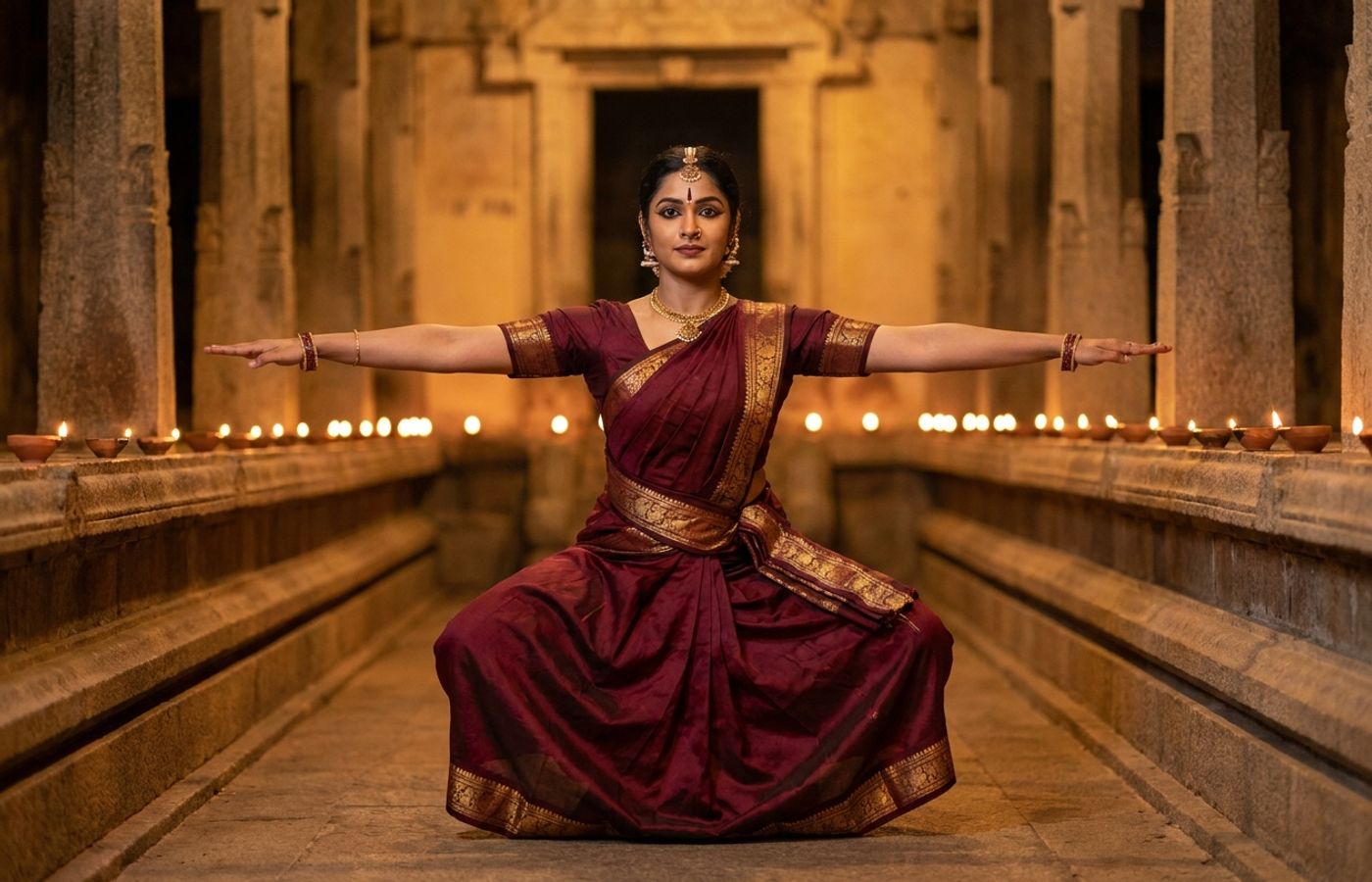
The tandava dance is the vigorous, expansive, rhythmically charged movement that Hindu tradition attributes to Shiva. It is the dance of the god who sets the universe turning, holds it steady, and dissolves it again. For a student of Bharatanatyam, though, tandava is not only mythology. It is a working principle, a quality of energy that decides how a step lands, how the torso holds its line, and how a jathi cuts cleanly through the tala.
Most searches about tandava lead to temple bronzes, stotrams, and retellings of the cosmic dance. Those are worth knowing, and we will come to them. But if you or your child are training seriously, whether in our studio in Lexington, Kentucky or online from another corner of the diaspora, the more useful question is a practical one. What does tandava ask of a dancer, and how does it live alongside its counterpart, lasya, inside the same margam? That is what this guide sets out to answer.
What the Tandava Dance Actually Is
In classical usage, tandava names a manner of dancing rather than a single choreography. Its character is uddhata, meaning forceful, elevated, and full of vigor. Wide stances, strong extensions, sharp footwork, and clear rhythmic attack all belong to it. What tandava is not is chaos. The force is measured. Every angle of the limb, every turn of the head, every landing of the foot is named in the tradition and can be taught, corrected, and repeated.
Its counterpart is lasya, described as sukumara: delicate, tender, flowing. Lasya carries the softer emotional colours, especially sringara, the mood of love. The two are not rivals. Classical theory treats them as complementary qualities that a complete dancer must command, in the same way a musician must command both a thundering passage and a whispered one.
Tandu, Bharata, and the Natya Shastra
The oldest surviving treatment of dance grammar in the Indian tradition is the Natya Shastra, attributed to the sage Bharata. Its account of tandava is specific. Shiva, having danced, instructed his attendant Tandu to convey that dance to Bharata along with its structural units. The tradition takes the very name tandava from Tandu. This is why the chapter dealing with these movements is known as the Tandava Lakshanam, the description of tandava.
The text sets out 108 karanas, which are units of movement combining the position of the feet, the legs, the torso, and the hands, and 32 angaharas, which are sequences built by linking karanas together. These are not decorative poses. They are the grammar from which movement is assembled. On the eastern gopuram at Chidambaram, the great temple of Nataraja, the karanas appear carved in stone, which tells you how central this vocabulary was to temple culture and to the dancers who served it.
Reading the Ananda Tandava of Nataraja
The Nataraja image that most people recognise depicts the Ananda Tandava, the dance of bliss. Each element carries meaning. The damaru in the upper right hand sounds the pulse from which creation begins. The flame in the upper left is dissolution. The lower right hand is held in abhaya hasta, the gesture that removes fear. The lower left sweeps across the body in gajahasta, pointing towards the raised foot, which stands for release. The other foot presses down on Apasmara, the small figure of ignorance and forgetfulness. Around the whole figure runs the prabhavali, a ring of fire.
For a dancer, the most instructive detail is the face. Amid all that motion, Nataraja's expression is composed. That is the lesson we return to constantly in class. Vigour belongs to the limbs and to the rhythm. The face carries the bhava, and it should never dissolve into effort or strain. A student who is grimacing through a fast jathi is telling the audience about their own fatigue rather than about the dance.
The Many Forms of Tandava
Tradition speaks of several named tandavas, and the lists differ from text to text and region to region. Commonly cited among them are the Ananda Tandava of bliss, the Sandhya Tandava danced at dusk, the Samhara or Rudra Tandava of dissolution, the Tripura Tandava, the Urdhva Tandava with its dramatic raised leg, the fierce Kalika Tandava, and the gentler Gauri Tandava. Each is associated with a different mood and a different moment in the myths.
It is worth holding these lists lightly. They come from a long and layered tradition, not from a single fixed doctrine, and honest teaching says so rather than presenting one version as the only version. What matters for practice is the underlying idea. The same dancer must be able to shift between joy, terror, majesty, and tenderness without losing control of line or tala.
Lasya, the Other Half of the Same Art
If tandava is associated with Shiva, lasya is traditionally associated with Parvati. Where tandava expands, lasya curves and yields. It lives in the tilt of the neck, the softening of the wrist, the sustained glance held one beat longer than expected. In the Bharatanatyam repertoire it dominates abhinaya items such as padam and javali, where a single line of poetry may be explored for many minutes through expression alone.
One misconception deserves correcting plainly. Tandava is not the men's dance and lasya is not the women's dance. They are qualities of movement, not assignments by gender. A young girl performing a crisp korvai in muzhumandi is dancing tandava. A male dancer portraying Yashoda soothing the infant Krishna is dancing lasya. Any serious curriculum trains both energies in every student.
Where Tandava Shows Up in a Bharatanatyam Margam
You meet tandava on the very first day of training, long before anyone mentions Shiva. Aramandi, the half sitting position, is a tandava demand on the body: turnout held, spine lifted, weight settled. Tatta adavu asks the foot to strike the floor with clarity rather than force. Kuditta mettu, nattu adavu, and later the mandi adavus that take the dancer close to the floor all build the same stamina and the same rhythmic precision.
In the margam, that energy comes to the surface in the pure nritta items. Alarippu opens the body outward from stillness. Jathiswaram sets movement to a swara passage with no story to hide behind, so the rhythm must carry it. The jathis and teermanams of a varnam are the sharpest test, and the tillana that closes a recital is deliberately brilliant and percussive. Between these, in the sanchari passages of the varnam and in the padam that follows, the same dancer must drop into lasya and hold an audience with almost no movement at all. Learning to switch cleanly between the two is one of the real markers of progress.
How We Teach These Two Energies
Our approach follows guru-shishya parampara: one guru, one lineage, and a curriculum that moves in a deliberate order. Students learn the name and the meaning of what they are doing, not only the shape. A child who can tell you that she is in aramandi, striking a tatta adavu in adi tala, is a child who can correct herself at home. That understanding is what turns years of classes into an art the student actually owns.
Vigour also has to be safe. Tandava movement loads the knees, the ankles, and the lower back, so we warm up properly, insist that the knees track over the toes in aramandi, build depth gradually rather than forcing it, and treat floor work as something earned. Younger children work in shorter bursts with more repetition. This holds whether a student is in the studio in Lexington, Kentucky or joining from a living room several time zones away, and it is one reason our online students are held to exactly the same standards of alignment as those in the room.
Bringing Tandava Into Your Own Practice
If you are practising between classes, three habits help more than any amount of extra repetition. First, hold aramandi honestly for short, timed stretches rather than sinking and rising through it. Second, count aloud or keep tala with the hand while you dance, so that speed never comes at the cost of rhythm. Third, watch your own face in the mirror during fast passages and keep it calm, with the drishti travelling where the hand travels.
Tandava rewards patience in a way that surprises new students. The dancers who look most powerful on stage are rarely the ones working hardest in the moment. They are the ones whose stance, breath, and rhythm were built slowly enough to become automatic, leaving the face and the eyes free to tell the story. That is the standard we train towards, one adavu at a time, and it is open to any student willing to do the work, whether they are five years old or returning to the art at forty.
Common questions
What does tandava mean?
Tandava refers to the vigorous, forceful manner of dancing associated with Shiva. The tradition traces the name to Tandu, the attendant who, according to the Natya Shastra, conveyed the dance and its movement units to the sage Bharata. In practice it describes energy and attack in movement rather than one fixed choreography.
What is the difference between tandava and lasya?
Tandava is uddhata, meaning forceful and expansive, with wide stances, strong lines, and sharp rhythmic footwork. Lasya is sukumara, meaning delicate and flowing, and carries the softer moods, especially sringara. They are complementary qualities, and a complete Bharatanatyam dancer trains in both.
Is tandava only for male dancers?
No. Tandava and lasya are qualities of movement, not roles assigned by gender. Female students dance tandava every time they execute a crisp korvai in aramandi or muzhumandi, and male dancers regularly perform tender lasya passages in abhinaya. A serious curriculum trains both energies in every student.
Where does tandava appear in a Bharatanatyam recital?
It is strongest in the pure nritta items: alarippu, jathiswaram, the jathis and teermanams of a varnam, and the tillana that closes a margam. Lasya dominates the sanchari passages, padams, and javalis. Most items move between the two, which is why switching cleanly is a key skill.
What do the 108 karanas have to do with tandava?
The Natya Shastra sets out 108 karanas, which are units of movement combining feet, legs, torso, and hands, along with 32 angaharas that link karanas into sequences. They form the grammar described in the chapter on tandava, and they appear carved on the eastern gopuram of the Nataraja temple at Chidambaram.
Can a beginner learn tandava movement safely?
Yes, when it is built gradually under a guru's eye. Tandava loads the knees, ankles, and lower back, so we warm up thoroughly, keep the knees tracking over the toes in aramandi, deepen the stance over months rather than weeks, and introduce floor based adavus only once the legs are ready. Younger children work in shorter, more frequent bursts.