intermediate
Samyukta Hastas: The 24 Combined Hand Gestures of Bharatanatyam
Samyukta hastas are the 24 two-hand gestures of Bharatanatyam, from Anjali to Avahittha. Learn their forms, meanings, and role in devotional pieces.
Samyukta hastas are the two-hand gestures of Bharatanatyam, the classical dance tradition that pairs precise technique with layered meaning. Where a single hand can sketch a bird or a blessing on its own, samyukta hastas ask both hands to work together, and the vocabulary they unlock is larger: the gods and their emblems, the avataras of Vishnu, an embrace, a vow, a bond between two people. At Sridevi Dance Academy in Lexington, Kentucky, and in our online classes for diaspora families across the country, samyukta hastas are taught only after a student's asamyukta hastas, the single-hand gestures, are secure. Two hands ask for twice the care.
What Is a Samyukta Hasta?
In Sanskrit, samyukta means joined or combined. A samyukta hasta is any hand gesture that requires both hands acting together, as opposed to an asamyukta hasta, which is formed with one hand alone. The Abhinaya Darpanam, the foundational treatise on gesture and expression traditionally attributed to Nandikeshvara and used across Bharatanatyam training, enumerates twenty-four such combined gestures. Each has a fixed form, a precise arrangement of both hands taught the same way in every generation, and a set of viniyogas, the range of meanings that same shape can carry depending on the story, the music, and the dancer's eyes and face.
Unlike the twenty-eight asamyukta hastas, which act as a kind of alphabet for smaller, everyday things, the samyukta hastas tend to speak of what is larger or more sacred. A single hand can suggest a leaf or a lamp's flame. Two hands together are needed for the conch, the discus, the Shiva-linga, or the boar and tortoise avataras of Vishnu.
The Twenty-Four Samyukta Hastas in the Bharatanatyam Tradition
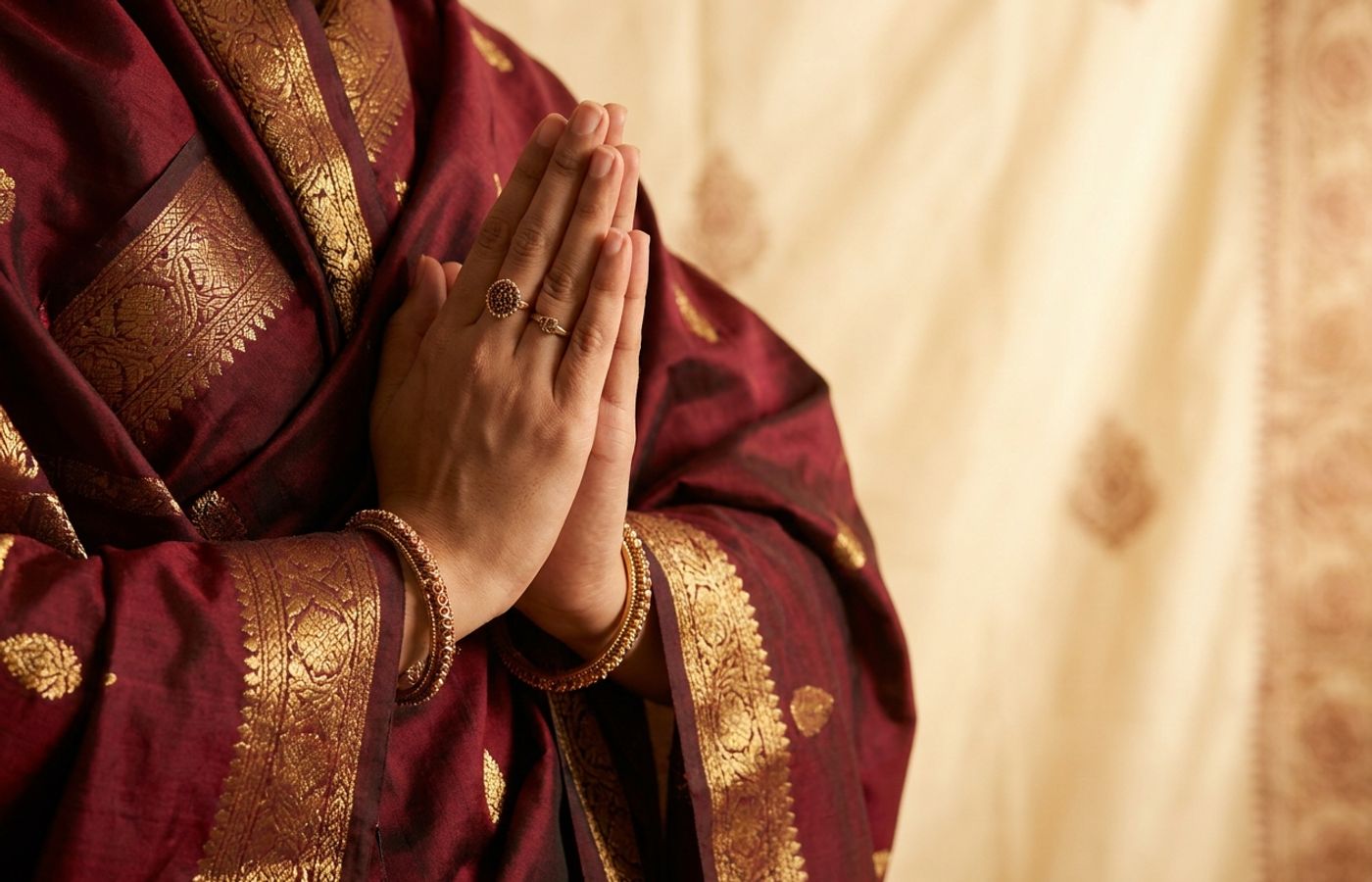
The samyukta hastas are learned in a fixed order, the same order recited in class at Sridevi Dance Academy. They begin with Anjali, two Pataka hands joined palm to palm in salutation to the gods, to one's guru, and to the audience, and they end with Avahittha, two Alapadma hands crossed on the chest to show shy concealment. Between the two sit gestures for an oath (Kapota), a crowd (Karkata), a crocodile or hesitant speech (Swastika), and the relaxed opening stance of a performance (Dola).
A significant portion of the twenty-four are devotional. Pushpaputa, formed by joining two cupped hands side by side, is used to offer flowers or to make an arati, a lamp offering. Shivalinga, Shankha, and Chakra carry the emblems of Shiva and Vishnu onto the stage. Matsya, Kurma, Varaha, and Garuda give physical shape to the fish, tortoise, and boar avataras of Vishnu, and to Garuda, his eagle mount, so a dancer performing a devotional piece or an item on the Dashavatara can show these forms without a single spoken word. Others describe human bonds: Kilaka for the playful, teasing conversation of lovers, Utsanga for an embrace, and Katakavardhana for a coronation or a wedding blessing.
A number of the twenty-four exist to carry a story forward. Pasha, formed by hooking the forefingers of both hands together, shows a noose, a chain, or open enmity between two characters. Nagabandha, made from two Sarpashirsha hands crossed at the wrist, becomes a pair of entwined serpents or a bower of creepers, useful in a piece set in a garden or a forest. Khatva, built from two Chatura hands stacked one on the other with the fingers pointing down like legs, becomes a cot, a bed, or a palanquin, while Samputa, a closed cup formed from the Chakra hands, becomes a casket used to conceal or reveal an object in mime. Bherunda, joined at the wrist from two Kapittha hands, completes the set as a pair of birds. None of these is decorative. Each earns its place because a single hand cannot hold the idea it is asked to carry.
Built From the Single Hands
No samyukta hasta stands alone. Every one of the twenty-four is built from asamyukta shapes a student already knows, which is why the single-hand gestures always come first in training. Two Pataka hands joined together become Anjali. Two Katakamukha hands crossed at the wrist become Katakavardhana. Two Ardhachandra hands held open at right angles become Chakra, the discus. This is one reason precision matters so much in Bharatanatyam: a samyukta hasta is only as clean as the two single-hand shapes hidden inside it, and a guru will correct a student's asamyukta hastas long before introducing the combined gesture that depends on them.
Symmetry, Not Duplication
A common misunderstanding is that a samyukta hasta simply means holding the same shape in both hands. Some, like Anjali or Swastika, do mirror each other exactly. Many others do not. Shivalinga pairs a Shikhara hand with an Ardhachandra hand. Shankha pairs a Shikhara hand with a flat, clasping palm. Nagabandha, the serpent-tie used for entwined snakes or a bower of creepers, crosses two Sarpashirsha hands at the wrist rather than joining them evenly. Learning which single hand goes where, and how the two relate to each other in space, is as much a part of the gesture as the final shape.
Precision and Safety in Practice
Because a samyukta hasta asks two hands to hold tension against each other, often at the wrist, sloppy practice can strain a young student's joints as easily as it can blur the meaning of the gesture. At Sridevi Dance Academy, that risk is treated as seriously as the artistry. Founder Sridevi Thyagarajan approaches every hasta with the same measured precision she brings to her work in pharmaceutical microbiology: a shape is built slowly from its correct asamyukta parts, checked for symmetry and comfort, and only then set to counts of tala, the rhythmic cycle, so that speed never arrives before the joints are ready for it. The result is a training path where students build strength and control at the same pace as vocabulary, rather than forcing an advanced gesture before the hands and wrists can safely hold it.
Where Samyukta Hastas Appear in a Bharatanatyam Margam
Samyukta hastas open and close nearly every piece a student performs. A margam, the traditional sequence of dance items that carries a dancer from pure movement toward pure expression, begins with a namaskaram, and that namaskaram is built on Anjali. Devotional items such as a keertanam, or a piece addressed to Vishnu or Shiva, lean heavily on the avatara and emblem gestures. In abhinaya, the expressive storytelling at the heart of a varnam or a padam, a dancer moves fluidly between asamyukta and samyukta hastas as the narrative shifts from a single figure to a relationship between two.
Learning Samyukta Hastas at Sridevi Dance Academy
At Sridevi Dance Academy, samyukta hastas are taught within a structured, multi-year curriculum that carries students from adavus through jathiswaram and varnam toward a full margam, always inside the guru-shishya parampara, the one-on-one relationship between teacher and student at the center of this art. Founder Sridevi Thyagarajan, a Senior Supervisor in Pharmaceutical Microbiology by profession, brings the same exactness she applies in the laboratory to every hasta: each shape is measured, named, and understood, not simply copied. Students recite the names of the samyukta hastas in order while forming each one with both hands, checking every shape against the asamyukta hastas it is built from before adding meaning.
Classes are offered in person in Lexington, Kentucky, and online for diaspora families across the country who want their children, or themselves, to learn this tradition accurately rather than approximately. Small, disciplined batches mean a guru can watch both hands at once and correct a samyukta hasta before it becomes a habit.
Ready to Learn the Hastas of Bharatanatyam?
Whether you are a parent exploring classical training for a child, an adult beginner returning to your roots, or a current student who wants to understand the samyukta hastas more deeply, Sridevi Dance Academy welcomes you to begin the way every Bharatanatyam student does: with the hands, learned exactly, in Lexington, Kentucky or online from anywhere in the diaspora. Schedule a trial class, explore the full curriculum, or read more from the studio to see how far one gesture, joined by both hands, can carry an entire story.
Common questions
What are samyukta hastas in Bharatanatyam?
Samyukta hastas are the combined, two-hand gestures of Bharatanatyam. The Abhinaya Darpanam counts twenty-four of them, each built from single-hand asamyukta shapes and used to show gods, emblems, avataras, and relationships between two people.
How many samyukta hastas are there?
The classical tradition, following the Abhinaya Darpanam, recognizes twenty-four samyukta hastas, from Anjali (salutation) at the start to Avahittha (concealment) at the end of the traditional order.
What is the difference between samyukta and asamyukta hastas?
Asamyukta hastas are formed with one hand alone, twenty-eight in number, and act like an alphabet for individual things. Samyukta hastas use both hands together, twenty-four in number, and are built from asamyukta shapes to show larger or more sacred ideas, such as the avataras of Vishnu or an embrace.
Which samyukta hasta opens a Bharatanatyam performance?
Anjali, formed by joining two Pataka hands palm to palm, is the salutation gesture that opens the namaskaram at the start of a margam, offered to the gods, to the guru, and to the audience.
Do students learn asamyukta or samyukta hastas first?
Asamyukta, single-hand hastas come first. Since every samyukta hasta is built from two asamyukta shapes, a guru will make sure a student's single-hand gestures are precise before introducing the combined ones.
Where can I learn samyukta hastas near Lexington or online?
Sridevi Dance Academy teaches samyukta hastas as part of its structured Bharatanatyam curriculum, in person in Lexington, Kentucky, and online for students and diaspora families anywhere in the country.