intermediate
Navarasa in Bharatanatyam: The Nine Rasas Explained
A guru's guide to navarasa in Bharatanatyam: what the nine rasas are, how bhava becomes rasa, and the eye, neck and head training behind real abhinaya.
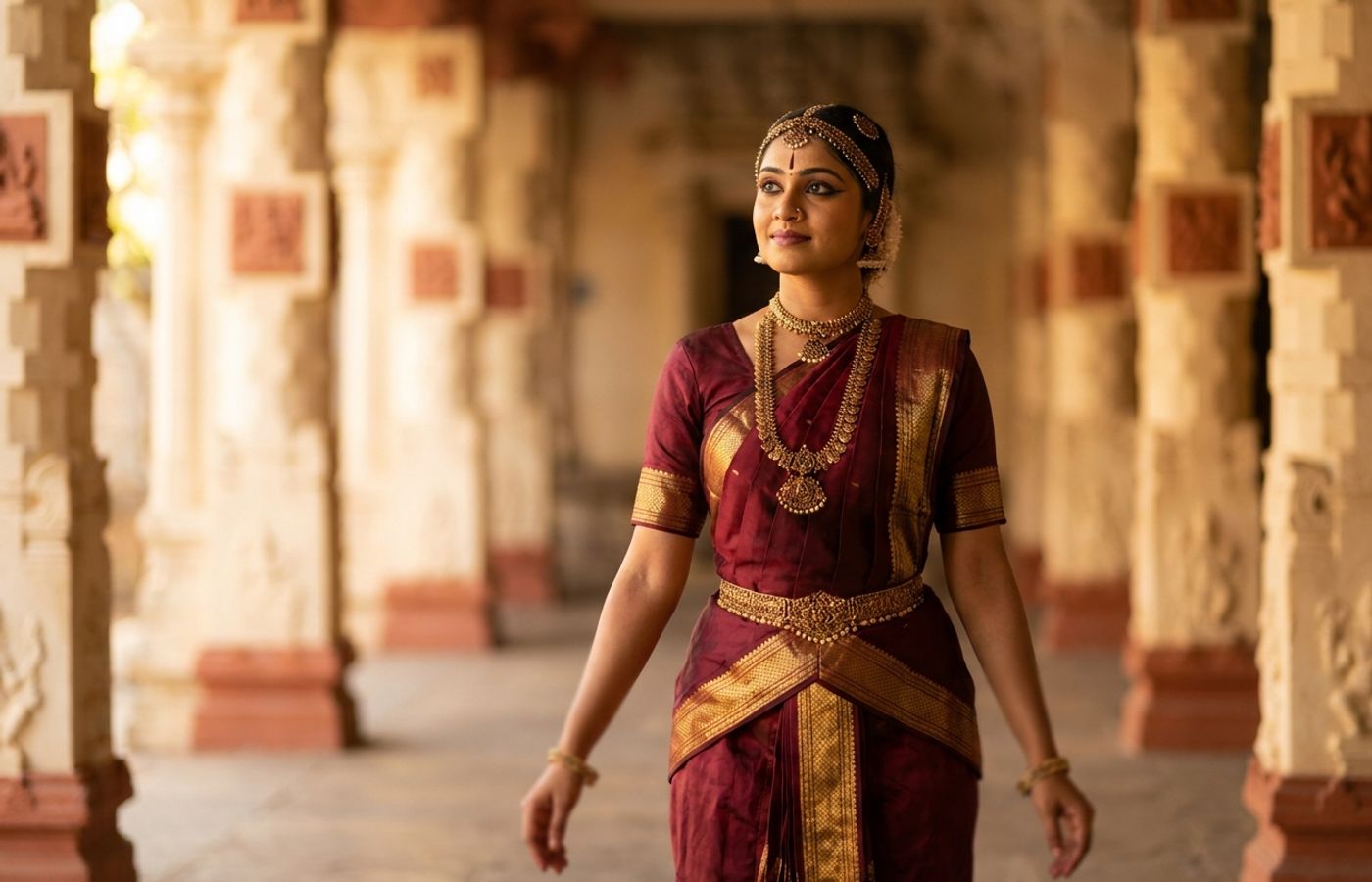
Ask a student what navarasa in Bharatanatyam means and most will answer with a list: nine emotions, nine faces, nine expressions to rehearse in front of a mirror. The list is correct as far as it goes. It is also the smallest part of the subject. In classical understanding the navarasa are not nine masks a dancer puts on and takes off. They are nine flavours that arise in the person watching, and the dancer's task is to build the conditions in which they can arise at all.
This guide covers the nine rasas as they are taught in class, the distinction between bhava and rasa that most online lists skip, and the physical training that has to be in place before expression becomes believable. It reflects how we teach at Sridevi Dance Academy, in our studio in Lexington, Kentucky and in online classes for diaspora families across the United States.
What navarasa in Bharatanatyam actually means
Nava means nine. Rasa is harder to translate cleanly: juice, sap, essence, taste. The word belongs to the vocabulary of food before it belongs to the vocabulary of art, and that is deliberate. A rasa is savoured, the way a diner savours a dish that has been correctly seasoned. The dancer is closer to the cook than to the ingredient.
The theory comes from the Natya Shastra, the foundational Sanskrit treatise attributed to Bharata Muni. Its formulation says rasa arises from the coming together of vibhava, anubhava and vyabhichari bhava: the causes of an emotion, the visible reactions to it, and the passing states that colour it. Nothing there tells the dancer to feel an emotion and display it. The emphasis falls on assembling the conditions.
One point of accuracy that gets flattened in most articles: the Natya Shastra sets out eight rasas. Shanta, the rasa of peace, was established through the later commentarial tradition and is now counted as the ninth in dance practice. When a Bharatanatyam teacher says navarasa, she is speaking from that settled tradition of nine, and each rasa carries a traditional presiding deity and colour association alongside its emotional core.
Bhava and rasa are not the same thing
This is the distinction that separates a student who has memorised nine faces from a student who is beginning to understand abhinaya. Bhava is what lives in the dancer and shows on the dancer. Rasa is what forms in the rasika, the sensitive spectator. The dancer works in bhava. Rasa is the result, and it is never fully in the dancer's control.
Within bhava there are further layers. Sthayi bhava is the stable, dominant state that anchors a whole passage: rati for love, shoka for grief, krodha for anger. Sanchari or vyabhichari bhavas are the transient states moving across that anchor, the flicker of doubt or shyness that keeps a long passage alive. Vibhava is the cause, anubhava the consequent expression that the audience can see, and sattvika bhava the involuntary layer that cannot be manufactured on demand.
A student who understands this stops asking how to make the karuna face. She starts asking what has happened to this character, who she is addressing, and what she wants. The face follows. That reversal of order is the single most useful thing a teacher can hand a student in the first years of abhinaya work.
The nine rasas, one by one
Shringara, the rasa of love and beauty, rests on the sthayi bhava of rati. It is the most extensive rasa in the repertoire and far broader than romance: union and separation, devotion to a deity, longing, the tenderness between mother and child. In padams and javalis it is often the whole subject, sustained on the strength of the eyes alone.
Hasya, laughter and mirth, rests on hasa. In Bharatanatyam it usually arrives as gentle wit rather than broad comedy: the teasing of Krishna by the gopis, a friend mocking a lovesick heroine, a child's mischief. It is taught carefully because students tend to overplay it, and overplayed hasya collapses the dignity of the form very quickly.
Karuna, compassion and sorrow, rests on shoka. It is the rasa of the separated heroine, of loss, of pleading, and it is demanding because it must be restrained. The temptation is to weep. The tradition asks instead for stillness with weight behind it, so the audience supplies the grief rather than being handed it.
Raudra, fury, rests on krodha. It appears in the fierce forms of the deities, in Durga, in Narasimha, in the tandava aspect of Shiva. Raudra lives in the whole body and not only the face: the aramandi drops lower, the chest lifts, the drishti hardens, the hastas take on force. A furious face on a soft body reads as pretence.
Veera, heroism and courage, rests on utsaha. Think of Rama drawing the bow, Arjuna at the head of an army, a devotee resolving to complete a difficult vow. Students often confuse veera with raudra. Veera is expansive, upright and forward moving. Raudra is compressed and destructive.
Bhayanaka, fear and terror, rests on bhaya. It shows in narrative sequences: the demon approaching, the forest at night, the moment before a curse falls. The eyes lead, with a quick unsteady drishti and shallow breath carried into the chest and shoulders.
Bibhatsa, disgust and revulsion, rests on jugupsa. It is the least used rasa in a typical margam and appears mostly in demonic characterisation or in the rejection of something unclean. Because it is rare, students often learn it as caricature. Taught properly it is a small, precise withdrawal rather than a grimace.
Adbhuta, wonder and amazement, rests on vismaya. This is the rasa of Yashoda seeing the universe in the mouth of the infant Krishna, of a devotee before a vision. Adbhuta opens the face and chest and lifts the drishti, and it pairs naturally with devotional themes throughout the repertoire.
Shanta, peace and tranquility, rests on a settled, desireless calm. It is the ninth rasa and the hardest to demonstrate, because it has almost no external action. Shanta is what a mature dancer arrives at rather than what a student performs, and it is usually recognised in the closing moments of a devotional piece rather than announced.
The training that makes rasa possible
Expression in Bharatanatyam is not a talent that some students have and others lack. It is built from named, drilled components, and this is where a structured curriculum earns its place. The bhedas come first. Drishti bheda trains the eyes to move independently and precisely. Shiro bheda governs the head. Griva bheda governs the neck, which is the hinge that makes the head and eyes read as one intention rather than three separate parts.
Alongside the bhedas sit the hastas, the single and joined hand gestures that carry meaning, and the eyebrow work most students discover they have never consciously used. Underneath all of it is aramandi, the half seated stance that keeps the body grounded while the face works. A dancer whose legs are unstable cannot hold a still face, because the effort leaks upward.
The tradition also names four kinds of abhinaya, and navarasa touches all four. Angika is expression through the body. Vachika is expression through the sung word, which in practice means understanding the sahitya being interpreted. Aharya is costume, ornament and stage presentation. Sattvika is the inner truth of the expression, the layer no amount of drilling can fake.
Where navarasa appears in the margam
The traditional margam is arranged so that expressive demand increases gradually. Alarippu and jathiswaram are nritta, pure rhythmic dance with no narrative content, and a student spends years there building line, timing and stamina. Shabdam introduces abhinaya in short phrases. The varnam is the centrepiece and the real test, alternating intricate nritta with extended expressive sections where a single line of text may be interpreted several ways.
Padams and javalis that follow the varnam are almost entirely abhinaya, and they live mostly in shringara and karuna. The tillana closes the margam and returns to nritta, with a brief expressive passage at its end. Understanding this architecture tells a student when navarasa training becomes urgent, which is well before the varnam and not the week the varnam is assigned.
What goes wrong when navarasa is learned from a list
Three errors show up repeatedly. The first is the disconnected face, where the expression is correct but the body has gone neutral, so the audience sees a performer demonstrating rather than a character behaving. The second is borrowing from film: cinematic acting is built for a camera a few feet away, Bharatanatyam abhinaya for an audience across a hall, and the two calibrations are not interchangeable.
The third is treating navarasa as a checklist displayed in sequence. Real repertoire rarely gives you nine clean emotions in a row. It gives you one sthayi bhava with a dozen sanchari bhavas moving through it, so the skill being tested is transition rather than display. A guru is usually watching the joins, not the poses.
How navarasa is taught at Sridevi Dance Academy
We teach within guru-shishya parampara, one guru and one lineage, with theory alongside technique from the beginning. A student learning drishti bheda also learns why the eyes are trained separately, and a student learning a padam learns what the sahitya says word by word. Abhinaya is introduced early in small doses and deepened each year, not saved for arangetram preparation.
Classes are small and disciplined, which matters more for abhinaya than for any other part of the curriculum, because expression has to be corrected individually and in the moment. We work with families in person in Lexington, Kentucky and online with diaspora students across the United States. The online format suits abhinaya well: the face fills the frame, so detailed correction is easy to see.
Practising navarasa between classes
Mirror practice is useful, but only with a cause attached. Choose a line of sahitya you understand, decide who is speaking and to whom, and let the expression come out of that decision. Work the eyes slowly and in isolation before adding head and neck. Keep the aramandi honest, and stop when the legs start to shake, because tired legs produce tense faces.
Recording yourself is worth more than a mirror, because a mirror lets you adjust as you go and abhinaya has to hold up without adjustment. Bring your questions to class rather than solving them alone, since the correction that unlocks a rasa is usually smaller and stranger than a student expects.
Navarasa in Bharatanatyam rewards patience more than natural expressiveness. The nine names take an afternoon to memorise and a career to inhabit, and that gap is not a failure of the student. It is the shape of the art. If you would like to begin that work with structured, guru-led training, we would be glad to hear from you.
Common questions
What are the nine rasas in Bharatanatyam?
The navarasa are shringara (love and beauty), hasya (laughter), karuna (compassion and sorrow), raudra (fury), veera (heroism), bhayanaka (fear), bibhatsa (disgust), adbhuta (wonder) and shanta (peace). The Natya Shastra sets out the first eight, and shanta was established through the later commentarial tradition. All nine are taught as standard in Bharatanatyam today.
What is the difference between bhava and rasa?
Bhava is the emotional state the dancer presents through face, body and gesture. Rasa is the flavour that forms in the audience as a result. The dancer works directly in bhava and creates the conditions for rasa, which is why the classical formulation describes rasa as arising from the combination of vibhava (the cause), anubhava (the visible reaction) and vyabhichari bhava (the transient states).
At what age can a child start learning navarasa?
Children usually begin Bharatanatyam with adavus, aramandi and basic hastas, and simple expressive work is introduced gently alongside that foundation. Structured navarasa training tends to deepen from the intermediate stage, once the bhedas for eyes, head and neck are reliable. How settled the physical foundation is matters more than the child's age.
Is navarasa unique to Bharatanatyam?
No. Rasa theory comes from the Natya Shastra and underlies Indian classical dance, drama and poetics broadly, so Kathak, Kuchipudi, Odissi, Mohiniyattam and other forms all work with the same nine rasas. What differs is the movement vocabulary, the repertoire and the stylistic conventions through which each form expresses them.
Can navarasa be taught properly in online Bharatanatyam classes?
Yes, and abhinaya is one of the areas where online teaching is genuinely strong. The face occupies most of the frame, so the guru can see detail in the eyes, eyebrows and neck clearly and correct it immediately. We teach diaspora students across the United States online alongside our in-person classes in Lexington, Kentucky.
How long does it take to learn navarasa well?
The nine names and their associated emotions can be memorised quickly, but making them convincing on stage is a multi-year process that runs parallel to the rest of the curriculum. Most students find their abhinaya changes noticeably once they begin working on a varnam, because that is where sustained interpretation is first demanded of them.