beginner
Kuchipudi and Bharatanatyam: The Real Difference
A guru's clear comparison of Kuchipudi and Bharatanatyam: origins, posture, rhythmic vocabulary, abhinaya, repertoire, and how to choose for your child.
Parents who grew up in India often ask us the same question after watching two performances back to back: what exactly is the Kuchipudi Bharatanatyam difference, and does it matter which one my child learns? It is a fair question. To an audience a generation or two removed from the temple towns of South India, the two forms can look like variations on a single idea. Both are set to Carnatic music. Both bend the knees and turn the feet out. Both speak with the hands. Yet a trained eye separates them within the first eight counts.
This guide walks through what actually separates them: where each tradition came from, how the body is held, how the rhythmic vocabulary is built, how emotion is carried, and how a full concert is shaped. We teach Bharatanatyam, so we will not pretend to neutrality about the form we know deeply. But an honest comparison serves a family better than a sales pitch, and understanding Kuchipudi will make you a sharper observer of Bharatanatyam.
Kuchipudi Bharatanatyam Difference: The Short Answer
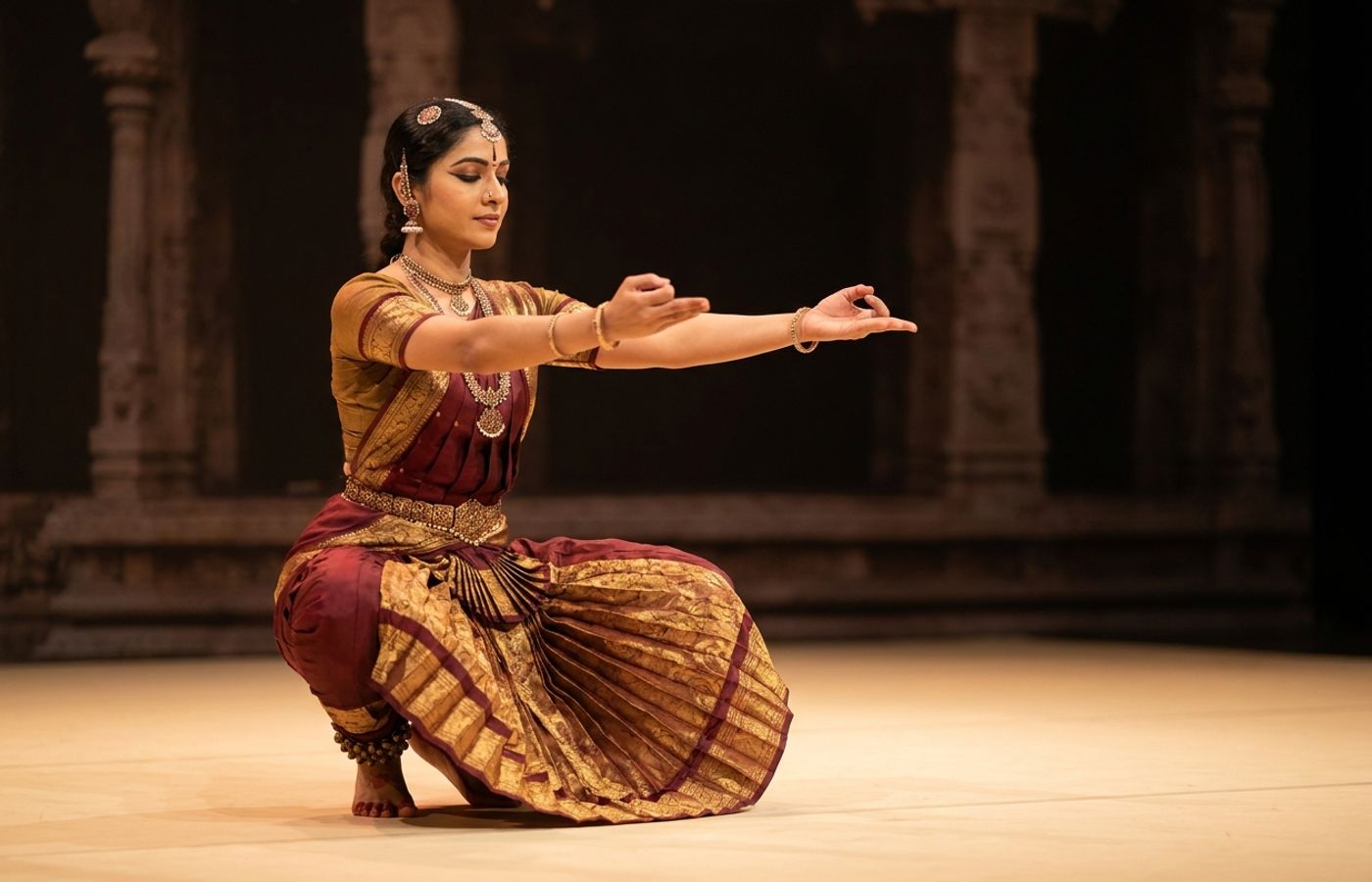
Bharatanatyam holds a line. Kuchipudi travels through one. In Bharatanatyam the dancer settles into aramandi, the half seated posture with the knees opened out over the toes, and stays there for most of a piece. Movement radiates from a torso that remains quiet and centered. The result is angular and geometric, closer to temple sculpture than to theatre.
Kuchipudi begins from the same half seated position, called ardhamandali in its Telugu speaking tradition, but treats it as a home base rather than a residence. The dancer rises, glides, turns, and drops back down. Footwork is quicker and lighter, the torso is freer, and there is a natural pull toward covering stage space. Kuchipudi grew out of dance drama, and that origin still shows in every sequence.
Two Regions, Two Origins
Bharatanatyam comes from Tamil Nadu, from the temple and court tradition once known as sadir, performed by hereditary artists trained inside a strict lineage. The four brothers of Thanjavur, remembered together as the Thanjavur Quartet, gave the solo concert its recognizable order in the nineteenth century. In the twentieth century, artists including Balasaraswati and Rukmini Devi Arundale carried the form onto the modern proscenium stage, the latter founding Kalakshetra and shaping the style many of us train in today.
Kuchipudi takes its name from a village in the Krishna district of Andhra Pradesh. Its tradition is credited to Siddhendra Yogi, remembered for composing Bhama Kalapam and for teaching the village families to perform it. For generations the form was a male dance drama, staged outdoors, with performers taking on named characters. The solo Kuchipudi repertoire audiences see at recitals today was shaped much later, in the twentieth century, by teachers such as Vedantam Lakshminarayana Sastry and Vempati Chinna Satyam.
That difference in origin explains most of what follows. One form was refined as a solo offering. The other was refined as a play.
How the Body Is Held
Watch the knees. A Bharatanatyam dancer sinks into aramandi at the start of an adavu and does not come out of it until the phrase closes. Depth of aramandi is one of the things a guru corrects most often, because the entire aesthetic depends on it. The thighs open, the spine lifts, and the arms extend along clean horizontal and diagonal lines. The body makes triangles.
A Kuchipudi dancer uses the same seated base but rises out of it far more often, and those transitions are part of the beauty. There are more leaps, more travelling turns, and more moments where the dancer stands at full height. The hips and torso participate visibly. Where Bharatanatyam reads as carved, Kuchipudi reads as spoken.
Adavus, Jathis, and the Rhythmic Alphabet
Bharatanatyam students spend years on adavus, the fixed rhythmic units that bind foot, leg, arm, hand, neck, and eye into one named step. Tatta adavu, natta adavu, mettu adavu and the rest are learned in strict order, each drilled to a tala before it is allowed into a composition. Jathis, the passages of pure rhythm inside a piece, are assembled from these units. The vocabulary is closed and precise, which is exactly why it can be taught cleanly across a multi year curriculum.
Kuchipudi has its own foundational steps and rhythmic training, but the grammar is looser at the edges and leaves more room for a dancer to shape a phrase in the moment. Footwork tends to be faster and more percussive, carrying a bounce that Bharatanatyam deliberately suppresses in favor of stillness.
Abhinaya and the Matter of Speech
Both forms rest on the same theory of expression. The Natya Shastra and the Abhinaya Darpana give both traditions the four divisions of abhinaya: angika through the limbs, vachika through speech, aharya through costume and ornament, and sattvika through genuine feeling. Both draw on a shared bank of hastas, the asamyukta hastas of one hand and the samyukta hastas of two, and both rely on shiro bheda, griva bheda, and drishti bheda to make the head, neck, and eyes speak.
The practical difference is vachika. Bharatanatyam is danced in silence by the performer. The vocalist sings, the nattuvanar keeps tala, and the dancer's face and hands carry the whole story. In traditional Kuchipudi the performer may sing, and in dance drama may speak in character. A Kuchipudi artist entering as Satyabhama in Bhama Kalapam announces herself aloud. That one convention changes how the form feels from the audience's seat.
The Shape of a Full Concert
A Bharatanatyam recital follows the margam, an order that builds on purpose. Alarippu opens the body. Jathiswaram tests pure rhythm. Shabdam introduces meaning. The varnam sits at the center and demands both stamina and interpretive depth, often running close to half an hour. The padams and javalis that follow are almost entirely expressive. A tillana returns to rhythm and speed, and a mangalam closes the evening. Every arangetram is built on this arc.
A Kuchipudi program may follow a comparable solo sequence, but it can just as easily be a dance drama with several performers, entrance songs called darus, and a narrative that unfolds scene by scene. The tradition never fully left the stage play behind.
The Brass Plate and the Pot
If you have seen a dancer balance on the rim of a brass plate while carrying a pot of water on the head, you were watching Kuchipudi. The item is called tarangam, danced to verses from Narayana Teertha's Krishna Leela Tarangini. It is the clearest visual marker between the two forms and has no equivalent in Bharatanatyam. The plate work is genuinely difficult and takes years to make look effortless.
Music, Costume, and Ornament
Both forms are set to Carnatic music, and both are accompanied by mridangam, violin, flute, and cymbals alongside a vocalist. In Bharatanatyam the nattuvanar leads with cymbals and spoken rhythmic syllables, a role that anchors the entire recital.
The costumes are cousins rather than twins. Both use a stitched costume with a pleated fan that opens at the knees in aramandi. Bharatanatyam costumes in the Tamil tradition are usually paired with kemp jewelry, the red and green stone settings borrowed from temple ornament, with the sun and moon placed at the parting of the hair. Kuchipudi costume and ornament differ in cut and detail, and dancers often wear a lighter arrangement suited to faster travelling movement. Salangai, the ankle bells, belong to both.
What the Two Forms Share
It is easy to overstate the distance between them. Both are classical forms recognized within the same Indian tradition. Both rest on the Natya Shastra. Both are taught guru to shishya, and both separate nritta, pure movement, from nritya, movement that carries meaning. A student who trains seriously in either one learns the same underlying discipline: tala living in the body, a still face that can become a character in an instant, and the patience to repeat a single adavu until the guru stops correcting it.
Neither is a beginner version of the other, and neither is easier.
Choosing a Form for Your Child
In most families the honest deciding factor is not aesthetics. It is access to a good teacher. A child who trains for eight years with one guru in a form that is well taught will go further than a child who chases a preferred style across three loosely connected teachers.
If your family has a regional connection to Andhra Pradesh and a strong Kuchipudi teacher nearby, that continuity is worth something real. If what draws you is the held line, the sculptural stillness, and a curriculum with a clearly mapped path from the first adavu to arangetram, then Bharatanatyam is the form to commit to. Ask any teacher you are considering how they sequence the first two years, how often students perform, and what the path to a full margam looks like. The answers will tell you more than a style label ever will.
Training in Lexington, Kentucky and Online
Sridevi Dance Academy teaches Bharatanatyam in Lexington, Kentucky and online to diaspora families across the United States. Students begin with aramandi and the first adavus, learn the theory and meaning behind each hasta rather than only its shape, and move through a structured multi year curriculum toward jathiswaram, varnam, and eventually a full margam. Classes stay small on purpose, because posture cannot be corrected from across a crowded room.
If you are still weighing which classical form suits your child, come and watch a class. Bring the questions above. A good guru will welcome them.
Common questions
What is the main difference between Kuchipudi and Bharatanatyam?
Posture and intent. Bharatanatyam holds the half seated aramandi almost continuously and builds angular, sculptural lines from a quiet torso. Kuchipudi uses the same seated base but rises out of it constantly, with faster footwork, more travelling movement, and a freer torso. Bharatanatyam was refined as a solo temple and court form in Tamil Nadu, while Kuchipudi grew out of dance drama in a village in Andhra Pradesh, and that theatrical origin still shapes it.
Is Kuchipudi easier than Bharatanatyam?
No. Neither form is a simplified version of the other. Bharatanatyam demands sustained strength in aramandi and years of adavu drilling before a student touches a varnam. Kuchipudi demands speed, elevation, sung and spoken expression, and in items such as tarangam the ability to dance on the rim of a brass plate. Both require the same multi year commitment under one guru.
Do Kuchipudi and Bharatanatyam use the same hand gestures?
Largely yes. Both traditions draw on the hastas catalogued in the Abhinaya Darpana, the asamyukta hastas performed with one hand and the samyukta hastas performed with two. The gestures and their traditional meanings overlap heavily. What differs is how they are deployed in phrasing, tempo, and, in Kuchipudi, alongside the performer's own voice.
Can a child learn both Kuchipudi and Bharatanatyam at the same time?
We do not recommend it in the early years. The two forms train the body toward different defaults, particularly in how long the half seated posture is held and how freely the torso moves. A beginner learning both at once tends to blur each one. Build a clean foundation in a single form first. Cross training becomes far more useful once the body already knows its home style.
Which classical form is better for a beginner in the United States?
The one with a committed guru you can reach every week, in person or online. Style matters less than continuity of teaching. Bharatanatyam is the most widely taught classical form across the diaspora, which makes it easier to find a structured curriculum, regular performance opportunities, and a clear route to arangetram. If a strong Kuchipudi teacher is available to you and your family has that regional connection, that is a sound reason to choose it.
What is tarangam, and does Bharatanatyam have anything like it?
Tarangam is a Kuchipudi item danced to verses from Narayana Teertha's Krishna Leela Tarangini, in which the dancer performs on the rim of a brass plate, sometimes balancing a pot of water on the head. It is one of the most recognizable images in Indian classical dance. Bharatanatyam has no direct equivalent. Its comparable technical peak is the varnam, which tests stamina, rhythmic precision, and abhinaya across a single long composition.