beginner
Kerala Dance Forms: A Guide for Classical Dance Families
A guru's guide to Kerala dance forms, from Mohiniyattam and Kathakali to Koodiyattam, and what each one teaches a Bharatanatyam student.
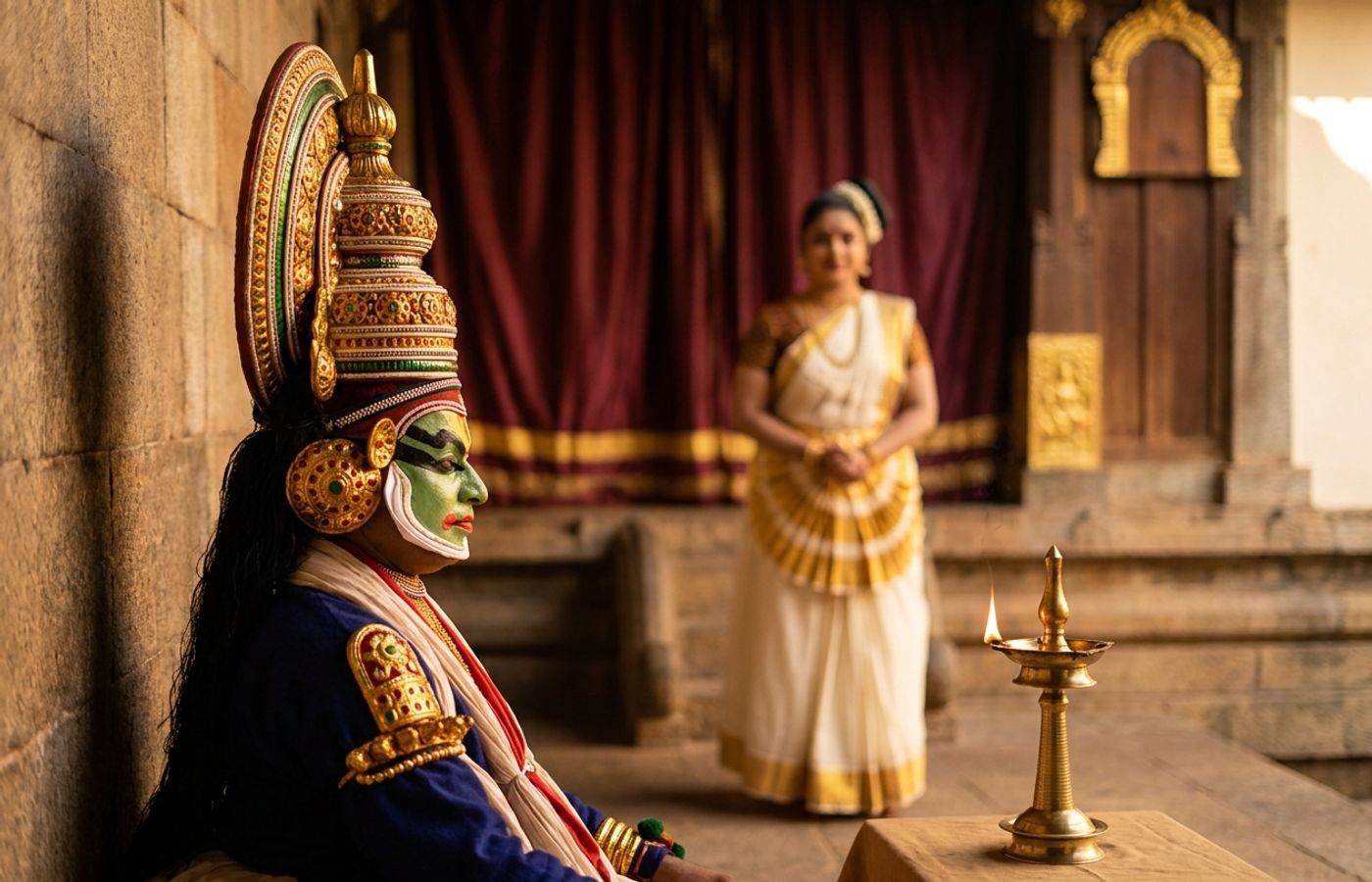
Families who study one classical form eventually start asking about the others. A student learns her adavus, watches a festival performance with a very different costume and a very different drum, and wants to know what she just saw. More often than not, what she saw was a Kerala dance form. The tradition next door to Bharatanatyam, shaped by a different language, a different temple culture, and a different set of drums, is one of the richest performing traditions in India, and it rewards a serious look.
This guide walks through the major forms of Kerala, what distinguishes each one, and how they relate to the Bharatanatyam our students train in here in Lexington, Kentucky and online with diaspora families across the country. The aim is not comparison for its own sake. It is to help you place your own training inside the wider map of Indian classical dance, so that you understand the form rather than simply perform it.
What Makes Kerala Dance Distinct
Every classical Indian form traces its theory back to the Natya Shastra, the ancient treatise that defines nritta, nritya, and natya, along with the four kinds of abhinaya and the navarasa. What separates one tradition from another is how that shared theory was carried, by whom, and in what setting.
In Kerala, the carriers were largely temple theatres and hereditary performing communities. Many of the state's forms are dramatic rather than solo. They tell a story with named characters, played over hours, with a live percussion ensemble driving the action. The percussion itself is distinctive: the chenda and the maddalam produce a sound that is heavier and more thunderous than the mridangam a Bharatanatyam student practices to. The language of the sung text is usually Malayalam or Manipravalam, a blend of Sanskrit and Malayalam, rather than the Tamil, Telugu, and Sanskrit compositions of the Carnatic margam.
Mohiniyattam: The Classical Solo Dance of Kerala
Mohiniyattam is the form most often named when someone asks about the classical dance of Kerala. The name comes from Mohini, the enchantress form taken by Vishnu, and the dance is built on lasya, the graceful and gentle quality, rather than the vigorous tandava.
The signature of Mohiniyattam is the swaying torso. Where Bharatanatyam holds a firm vertical line above a stable aramandi and moves in straight lines and clean angles, Mohiniyattam moves in soft circles. The body sways from side to side, the knees give gently, and even the arms travel along curved paths. A Bharatanatyam student watching for the first time usually notices the absence of sharp edges before anything else.
The costume is equally recognisable: an off-white kasavu set with a gold border, echoing the everyday Kerala mundu, with the hair gathered into a bun to one side and dressed with jasmine. Musically it draws on Carnatic ragas with a Sopana sensibility, the slow devotional singing style of Kerala temples. The form received significant royal patronage in nineteenth century Travancore, declined for a period, and was systematically revived in the twentieth century through the work of Kerala Kalamandalam, the institution founded by the poet Vallathol Narayana Menon.
Kathakali: Dance Drama with a Language of Its Own
Kathakali is the image most people carry of Kerala: the towering headgear, the sculpted green face, the vast skirt. It is a dance drama rather than a solo recital, and the stories come from the Ramayana, the Mahabharata, and the Puranas, set as attakathas, or performance librettos.
The makeup is a code, not decoration. Pacha, the green face, marks noble and divine characters. Kathi adds a knife shaped mark for the arrogant anti-hero. Thadi denotes bearded characters, Kari the demonic, and Minukku the gentle and refined roles. The raised white ridge along the jaw, the chutti, is built up on the actor's face over hours before the performance begins. A student who has spent years learning that costume and ornament carry meaning in Bharatanatyam will recognise the same principle at work, applied far more literally.
The most useful thing for a Bharatanatyam student to understand about Kathakali is that the actor does not speak. Vocalists sing the text while the performer delivers it entirely through mudras and facial expression, with the eyes doing extraordinary work. Kathakali training famously includes dedicated exercises for the eyes, cheeks, and eyebrows, because the face must carry a narrative across a large temple courtyard by lamplight.
Koodiyattam: The Oldest Living Sanskrit Theatre
Koodiyattam is Sanskrit theatre performed in Kerala's koothambalams, the theatre halls attached to temples. It is widely regarded as the closest surviving practice to the theatre described in the Natya Shastra, sustained across centuries by hereditary communities: Chakyars as actors, Nangyars in the women's roles, and Nambiars playing the mizhavu, the great copper drum. UNESCO recognised it in 2001 as a Masterpiece of the Oral and Intangible Heritage of Humanity.
What makes Koodiyattam remarkable is its patience. A single verse can be elaborated for hours through netrabhinaya and detailed hand gesture, and a full presentation may unfold over many nights. For a student trained to fill a short jathiswaram with precise footwork, watching an actor take twenty minutes over one line is a lesson in how much meaning abhinaya can hold when it is given room.
Ottamthullal, Krishnanattam, and the Temple Repertoire
Ottamthullal was created in the eighteenth century by the poet Kunchan Nambiar. It is a solo form, performed in Malayalam verse with a lighter costume and a quick, direct delivery, and it is known for its satire. Where Koodiyattam is slow and Sanskritic, Thullal speaks plainly to a general audience, and it often pokes fun at social pretension.
Krishnanattam is a cycle of eight plays on the life of Krishna, composed under Manaveda, the Zamorin of Calicut, and performed as an offering at the Guruvayur temple. It sits close to Kathakali in visual style and is usually discussed as part of the same lineage of Kerala dance drama.
Alongside these are the community and ritual traditions. Thiruvathirakali, also called Kaikottikali, is danced by women in a circle around a lit nilavilakku during the Thiruvathira festival, with songs on Shiva and Parvati. Theyyam, from north Malabar, is a ritual performance in which the performer takes on the form of a deity and is addressed as such. These are not classical concert forms, and it would be inaccurate to present them as such, but they are inseparable from how dance actually lives in Kerala.
How Kerala Dance Compares with Bharatanatyam
The most instructive difference for our students is the vocabulary of the hands. Bharatanatyam hastas are taught from the Abhinaya Darpana of Nandikeshvara, with twenty eight asamyukta hastas for one hand and a set of samyukta hastas for two. Kathakali and Koodiyattam draw on a different text, the Hastalakshana Deepika, which sets out twenty four basic mudras that combine into a very large working vocabulary. The two systems overlap in places and diverge in others, which is exactly why a mudra a student thinks she recognises on stage may be saying something quite different.
The body works differently too. Bharatanatyam is organised around aramandi, the half seated position, and around geometry: straight lines, sharp angles, symmetrical patterns cut into the floor by the feet. Mohiniyattam is organised around the curve. Kathakali sits in a wide, low, turned out stance with the weight carried on the outer edges of the feet, and the shoulders and chest hold a heroic quality that Bharatanatyam reserves for specific characters.
What is shared matters more than what differs. All of these forms are built on bhava and rasa, on the discipline of a guru teaching one shishya at a time, and on the idea that the body is an instrument for conveying meaning. A student who understands that idea in Bharatanatyam already understands the foundation of every form named above.
How We Use This in Class
We are a Bharatanatyam school, and our curriculum stays inside that lineage. We do not teach Mohiniyattam or Kathakali, and no serious school should claim to teach a form it has not trained in. What we do teach is context. When a student learns a hasta, she should know that other traditions codify the hands differently. When she learns why aramandi is held, she should know that another form deliberately does not hold it.
For our families in Lexington, Kentucky and for the diaspora students who join us online, that context does real work. Children growing up outside India often meet these forms at a festival or on a screen, out of order and without explanation. Knowing what they are looking at turns a spectacle into something they can respect, and eventually something they can speak about with confidence.
Where to Begin
If your family is drawn to Kerala dance specifically, look for a teacher trained in that lineage, ideally with a connection to Kerala Kalamandalam or a comparable institution. If you are choosing a first classical form for a child, the honest answer is that the tradition matters less than the seriousness of the training. A structured curriculum, a guru who explains the theory behind every movement, and steady weekly practice will serve a student in any lineage.
That is the standard we hold ourselves to. Our students move from adavus through alarippu and jathiswaram to varnam and the full margam, and at every stage they learn the reasoning, the terminology, and the tradition behind what their body is doing. If you would like to see how that works in practice, come and watch a class.
Common questions
What is the classical dance of Kerala?
Mohiniyattam is the classical solo dance form of Kerala, recognised alongside Bharatanatyam and the other major Indian classical forms. Kathakali, Kerala's classical dance drama, and Koodiyattam, its Sanskrit theatre tradition, are equally central to the state's performing culture, though they are ensemble and theatre forms rather than solo recital forms.
What is the difference between Kathakali and Mohiniyattam?
Kathakali is a dance drama with multiple characters, elaborate coded makeup and headgear, and a heavy chenda and maddalam percussion ensemble. Mohiniyattam is a solo form built on lasya, with a swaying torso, circular movement, and a simple off-white kasavu costume with a gold border. Kathakali tells a story through characters. Mohiniyattam presents it through a single dancer.
Is Kerala dance the same as Bharatanatyam?
No. Bharatanatyam comes from the temple and court tradition of Tamil Nadu and is organised around aramandi, sharp geometry, and Carnatic compositions in Tamil, Telugu, and Sanskrit. Kerala forms use different stances, different percussion, and texts in Malayalam or Manipravalam. All of them share the theoretical foundation of the Natya Shastra, which is why the underlying concepts of bhava and rasa carry across.
Do Kathakali and Bharatanatyam use the same mudras?
They use related but separate systems. Bharatanatyam hastas are taught from the Abhinaya Darpana, with twenty eight asamyukta hastas and a set of samyukta hastas. Kathakali and Koodiyattam follow the Hastalakshana Deepika, which lists twenty four basic mudras. Some hand shapes look similar across the two systems but carry different meanings, so they should not be treated as interchangeable.
Should my child learn a Kerala dance form or Bharatanatyam first?
Start with whichever form has a committed, well trained teacher available to you in person or online. Both traditions demand years of structured work, and the discipline transfers. What matters most for a young student is a guru who teaches the theory alongside the technique and a curriculum that progresses safely rather than rushing toward performance.
Can my family learn classical Indian dance in Lexington, Kentucky?
Yes. Sridevi Dance Academy teaches Bharatanatyam in person in Lexington, Kentucky and online for diaspora families elsewhere in the United States. We teach within our own lineage and do not offer Kerala forms, but we give students the cultural context to understand and appreciate them. You are welcome to schedule a trial class.