beginner
Is Bharatanatyam Hard? A Guru's Honest Guide for Beginners
Is Bharatanatyam hard? A guru explains where the challenge lies, how training is paced, and how beginners of any age can start in Lexington or online.
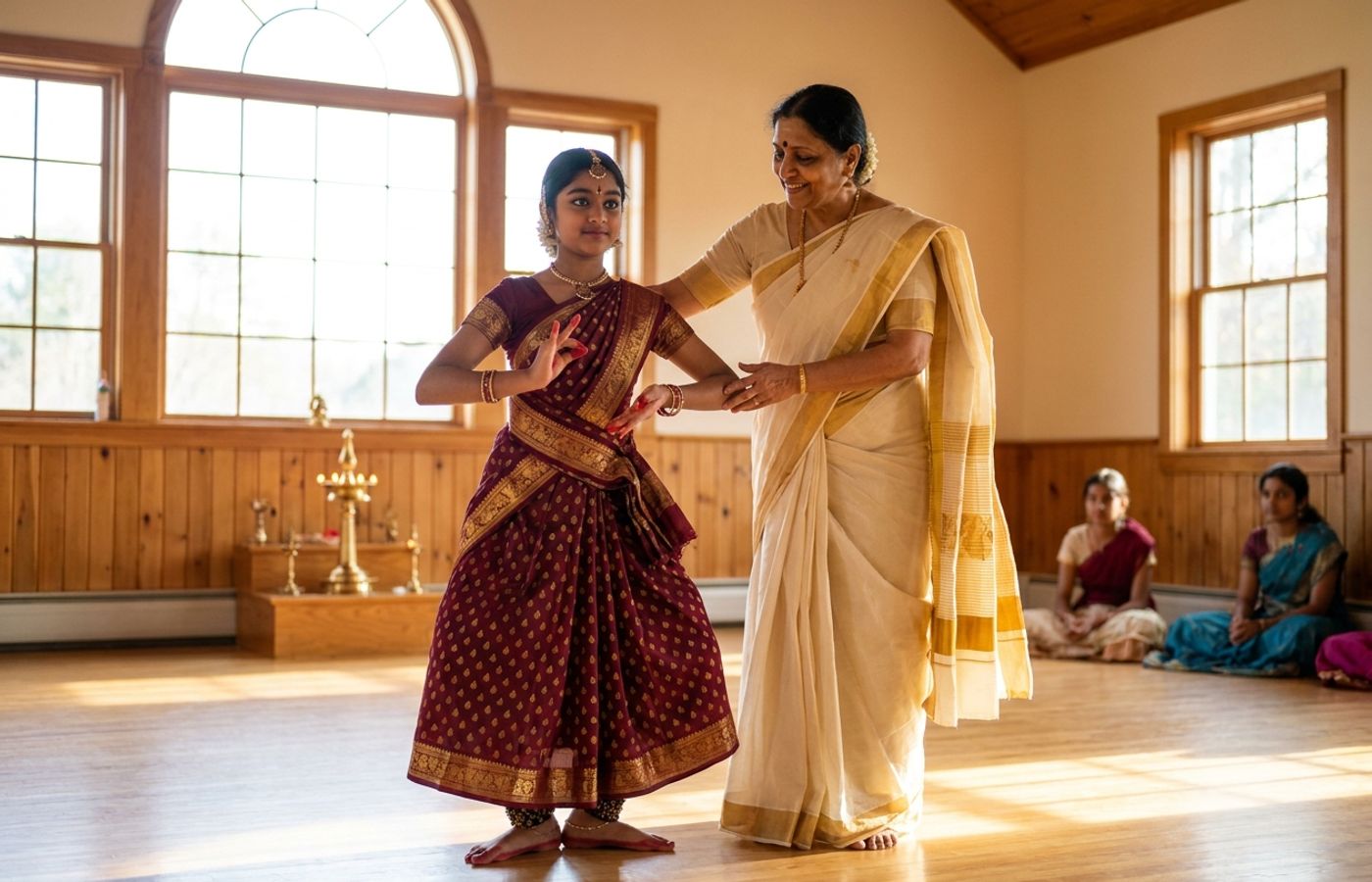
Is Bharatanatyam hard? Ask any dancer who has held aramandi through a full adavu sequence and you will get a smile before the answer. The honest reply is yes, it is demanding, and it is also learnable by almost anyone who comes with patience and a willingness to be taught step by step. If you are a parent in Lexington, Kentucky weighing classes for your child, or an adult in the diaspora thinking about returning to the art, this guide explains where the difficulty actually sits, how a guru builds it into manageable stages, and what you can do to make the first year feel steady rather than overwhelming.
So, is Bharatanatyam hard? Where the difficulty really lives
Bharatanatyam asks several things of the body and mind at once. The legs hold aramandi, the half-seated stance with knees turned outward and the spine lifted. The arms and hands carry hastas, the torso stays centered, the eyes follow the gesture, and all of it moves in time with a tala, the rhythmic cycle that organizes the music. Beginners rarely find any single piece impossible. What feels hard in the first months is doing several pieces together while a guru watches for precision.
It helps to separate the difficulty into three kinds. The first is physical: stamina in the thighs, steady balance, flexibility in the hips and ankles. The second is technical: learning the grammar of nritta, which is pure dance built from adavus, along with the vocabulary of hastas and the bhedas of the head, eyes, and neck. The third is expressive: abhinaya, the art of telling a story and conveying bhava, which grows slowly and deepens for as long as a dancer practices. Each kind of difficulty is real, and each responds to patient, structured training.
The physical side: aramandi, stamina, and a body that adapts
Aramandi is the first thing most students notice. Sitting into a half squat and then stepping, stamping, and turning from that position works the thighs and calves in a way that daily life does not. In the opening weeks it is normal to feel tired quickly. Muscles adapt when practice is regular and progression is sensible, so a good class builds the stance in stages: short holds, rests, simple adavus, then longer sequences as strength grows.
Safety matters here, and it is one reason we teach with care. Knees should track over the toes, the spine should stay long, and the dancer should never push through sharp pain. Our founder, Sridevi Thyagarajan, works as a Senior Supervisor in Pharmaceutical Microbiology, and that laboratory habit of measuring and checking shows up in her teaching. Alignment is observed, named, and corrected early, which protects young joints and adult knees alike. Students are encouraged to warm up, to rest when needed, and to tell the guru when something feels wrong.
The technical side: adavus, hastas, and the grammar of the form
Adavus are the basic units of Bharatanatyam movement, and a student spends a long and rewarding stretch of time on them. Each adavu combines a footwork pattern, a hand position, a stance, and a rhythm. At first, a single adavu can feel like juggling. Then something clicks. The feet land on the beat, the hands arrive where they should, and the movement starts to feel like one gesture rather than four separate instructions. That moment arrives at a different time for every student, and a good guru does not hurry it.
Hastas, often called mudras, add a vocabulary of their own. There are single-hand gestures, the asamyukta hastas, and double-hand gestures, the samyukta hastas, and each one has a name, a shape, and traditional meanings that students learn over time. Alongside them come the shiro bheda for the head, the drishti bheda for the eyes, and the griva bheda for the neck. Learning these is closer to learning a language than memorizing steps, which is why we teach the theory and meaning with the technique. A student who understands why a gesture means what it means remembers it far better.
The expressive side: abhinaya cannot be rushed
Many new students expect the feet to be the challenge and are surprised that expression asks just as much. Abhinaya is the part of Bharatanatyam where a dancer becomes a storyteller, using face, eyes, and hands to portray a character or a feeling. Children often take to it naturally because they are unselfconscious. Adults sometimes find it the most vulnerable part of training. Both groups improve the same way, through repetition, listening to the lyrics, and a guru who explains what each line is saying and where the emotion should land.
This is also where the art stops being only exercise. Understanding a padam or a verse from a varnam, and feeling how the music and the movement answer each other, is what keeps dancers returning for years. It is hard in the way that good things are hard: it asks for attention, and it rewards it.
Bharatanatyam compared with other classical forms
Parents and adults often ask whether Bharatanatyam is harder than another classical form such as Kathak. Honest comparison is difficult, because each tradition builds a different set of strengths. Bharatanatyam is known for its sustained aramandi, its sharply defined lines, and its tight link between rhythm and gesture. Kathak emphasizes spins and a different relationship with the floor. Neither is simply easier. The better question is which form a student feels drawn to, because motivation changes how difficult any training feels. If you are curious about the contrast, our guide to the difference between Kuchipudi and Bharatanatyam is a good place to see how closely related forms still differ.
Is Bharatanatyam hard for children, and for adults?
Children between roughly five and sixteen tend to pick up movement quickly and recover fast, so the early challenge is usually focus and consistency rather than ability. Short, well-paced classes, clear goals, and a warm teacher make a large difference. Parents can help by encouraging a few minutes of home practice rather than long, tiring sessions. If you are weighing the decision for your child, our parent guide to Bharatanatyam classes for kids walks through what to look for.
Adult beginners often worry that they have started too late. Bharatanatyam is traditionally associated with early training, but adults learn it successfully, particularly those returning to their roots or coming to classical dance for the first time. Adults usually bring discipline and the ability to understand theory, and they progress at a pace set by their own stamina and flexibility. The structure of a good curriculum, taken one adavu at a time, makes the path clear no matter the starting age.
How a good curriculum makes it manageable
Difficulty becomes manageable when it arrives in the right order. Our training follows the traditional margam, the sequence of items in a Bharatanatyam repertoire, and it begins with foundations. Students first learn aramandi and basic adavus, then simple hastas, then short combinations set to tala. Later come items such as alarippu, jathiswaram, and eventually the varnam, which combines pure dance and expression at length. Each stage is built on the one before it, so a student is rarely asked to do something that the previous months have not prepared them for.
The guru-shishya parampara, the lineage of teaching passed from guru to student, is central to this. A guru watches a shishya closely, notices what is ready and what is not, and adjusts. That individual attention is hard to replace, and it is why small, disciplined classes matter. It is also why a student who feels lost in a large group can feel steady in a smaller one.
Learning in Lexington, Kentucky or online
Distance should not decide whether a family can pursue serious training. We teach in person in Lexington, Kentucky, and we also teach online for families across the diaspora who want guidance rooted in tradition without a local studio nearby. Online classes work well when the student has a clear view of the screen, a few square feet of clear floor, and a parent or adult nearby for younger children. The guru can still correct stance, hand position, and rhythm, and students still build the same steady foundation.
Practical ways to make the first year easier
A few habits help almost every beginner. Attend regularly, because the body learns through repetition more than through intensity. Practice a little at home, even ten focused minutes. Wear comfortable clothing that lets the teacher see the knees and feet. Listen to the music you are learning so that tala begins to feel natural. Ask questions about meaning, since understanding makes memory stronger. And be patient with yourself: no one expects aramandi to feel easy in the first month, and no guru is surprised when it does not.
It also helps to remember what the difficulty is for. Training the body to hold a stance, the mind to count a rhythm, and the face to carry an emotion produces a dancer who is steady in many ways. Many students find that the discipline carries into schoolwork, careers, and everyday life. That is part of the reason families stay with the art for many years.
So should you start?
Yes, if you are drawn to it. Bharatanatyam is hard in the way any serious craft is hard, and it is also generous to those who approach it with respect and regularity. The best way to find out how it feels is to try a class, meet the guru, and see whether the movement and the music speak to you. Our studio welcomes beginners of all ages, and a trial class is a gentle, no-pressure way to take the first step.
Common questions
Is Bharatanatyam hard to learn for a complete beginner?
It is demanding, but beginners learn it every day. The first months focus on aramandi, basic adavus, and simple hastas, introduced in small stages. With regular attendance and a patient guru, most students find the early difficulty eases as strength and coordination grow.
Is Bharatanatyam harder than Kathak?
Neither form is simply harder. Bharatanatyam is known for its sustained half-seated stance and sharply defined lines, while Kathak emphasizes spins and different footwork patterns. The right choice is the one a student feels drawn to, since motivation changes how difficult any training feels.
Can adults learn Bharatanatyam if they never danced before?
Yes. Adults successfully begin Bharatanatyam, including those returning to their roots. They progress at a pace set by their own stamina and flexibility, and a structured curriculum taken one adavu at a time keeps the path clear.
What is the hardest part of Bharatanatyam?
It depends on the student. Many find aramandi and stamina hardest at first, others find coordinating hastas with rhythm tricky, and some find abhinaya, the expressive storytelling, the most challenging. All three improve steadily with guided practice.
How long does it take to feel comfortable with Bharatanatyam?
There is no fixed timeline, and quick results should never be promised. Many students begin to feel more at ease after several months of regular classes, once aramandi and the basic adavus start to feel familiar. Comfort deepens over years of training.
Can my child learn Bharatanatyam online if we are not near Lexington?
Yes. Sridevi Dance Academy teaches online as well as in person in Lexington, Kentucky. A clear view of the screen, a bit of open floor, and a parent nearby for younger children let the guru correct stance, hand position, and rhythm.