beginner
Hindustani Classical Music: A Guide for Dance Families
A clear guide to Hindustani classical music, its ragas, talas, and gharanas, and how it relates to Bharatanatyam and Carnatic music for dance families.
For families raising children in classical Indian dance, the music is never far from the movement. Every adavu is set to a rhythm, every abhinaya sequence rides on a melody, and a student who understands the sound behind the steps dances with far greater depth. Hindustani classical music is one of the two great classical music systems of India, and even though Bharatanatyam is set to the Carnatic tradition of the south, understanding Hindustani classical music gives diaspora families a fuller picture of the artistic world their children belong to. This guide explains what the tradition is, how it is built, and why it matters to a serious dance household in Lexington, Kentucky and across the online diaspora.
What Is Hindustani Classical Music?
Hindustani classical music is the classical music of North India, sometimes called North Indian classical music or Shastriya Sangeet. It shares an ancient root with the Carnatic music of South India, since both descend from the same body of theory found in early Sanskrit treatises. Over the medieval period the northern tradition absorbed Persian and Central Asian influences that arrived through the courts of the region, and it gradually grew into a distinct system with its own repertoire, instruments, and performance style. Today it is known for its meditative, improvisational character. A single raga can unfold slowly over a long stretch of time as the musician explores its shades before the rhythm ever enters. This patient, exploratory spirit is one of the clearest differences a listener will notice compared to the more composition-driven Carnatic style that accompanies Bharatanatyam.
Raga and Tala: The Two Pillars
Two ideas hold up the entire tradition: raga and tala. A raga is a melodic framework, not simply a scale. Each raga has a set of notes it may use, a characteristic way of ascending and descending, phrases that give it its identity, and an emotional mood. Many ragas are traditionally associated with a time of day or a season, so a morning raga carries a different feeling from an evening one. The seven basic notes, sung as Sa, Re, Ga, Ma, Pa, Dha, and Ni, are shared with the Carnatic system, which is why a Bharatanatyam student who already knows sollukattu and swaras will recognize the vocabulary quickly.
Tala is the rhythmic cycle. Rather than counting in fixed bars the way Western music often does, Hindustani music organizes time into repeating cycles of beats with recognizable accents. One of the most common is teental, a cycle of sixteen beats. The tabla player and the melodic musician play within and against this cycle, returning together to the first beat, called the sam, in a way that feels both structured and alive. Any dancer understands this instinctively, because holding a tala and landing cleanly on the sam is exactly the discipline that adavus and jathis train in Bharatanatyam.
The Voices and Instruments of the Tradition
Vocal music sits at the heart of Hindustani classical music. The oldest surviving vocal form is dhrupad, austere and majestic, prized for its purity and its deep exploration of the raga. The form most often heard in concerts today is khayal, which allows more ornamentation and improvisation. Lighter, more romantic forms such as thumri bring emotional expression to the front, which is why they connect so naturally to storytelling and dance. A typical performance often begins with the alap, an unmetered, meditative opening in which the artist reveals the raga note by note before the rhythm joins.
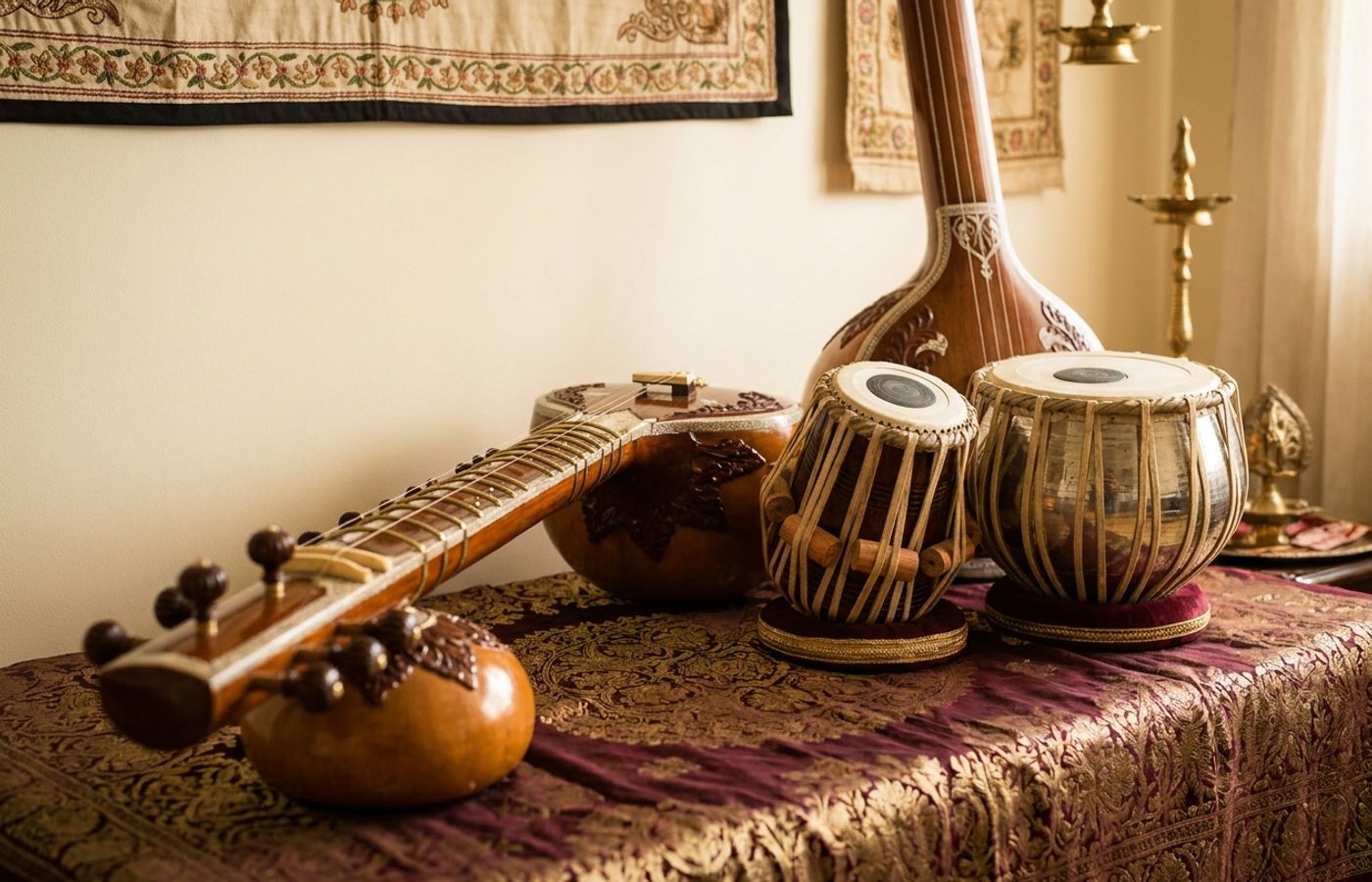
The instruments of the tradition are some of the most recognizable sounds of India. The sitar and the sarod carry melody on strings, while the bansuri flute, the sarangi, and the santoor each bring their own voice. The harmonium often supports a singer, and underneath it all sits the tanpura, whose steady drone anchors the pitch, alongside the tabla, the pair of hand drums that drives the rhythm. Many students first fall in love with the tradition through one of these instruments, and even a dancer benefits from learning to hear each one, because the same instruments and the same ideas of melody and rhythm shape the music they will perform to on stage. A simple listening habit at home, putting on a raga recording and asking a child to notice when the rhythm enters or when the drone shifts, quietly trains the ear that a dancer will one day rely on.
Gharanas and the Guru-Shishya Parampara
Hindustani classical music is organized into gharanas, which are lineages or schools, each with its own approach to phrasing, ornamentation, and interpretation. Schools such as Gwalior, Kirana, and Jaipur each carry a distinct identity handed down over generations. A gharana is not just a style. It is a chain of teachers and students, and a musician is understood partly through the lineage that trained them. This is the same guru-shishya parampara that shapes our own work at Sridevi Dance Academy. One guru, one lineage, and a body of knowledge passed carefully from teacher to student is how both classical music and classical dance have survived and stayed pure across centuries. When families understand gharana, they understand why lineage matters so much in the classical arts, and why a single dedicated teacher is worth more than a scattered collection of short courses.
How Hindustani Music Connects to Classical Dance
India has more than one classical dance form, and each is wedded to a musical world. Kathak, the classical dance of the north, is set to Hindustani classical music, and its footwork and spins converse directly with the tabla and the melodic line. Bharatanatyam, the classical dance of the south that we teach, is set to Carnatic music, with the mridangam, nattuvangam cymbals, violin, flute, and voice guiding the dancer. So while a Bharatanatyam student will not usually perform to Hindustani music, the two traditions are cousins. They share the same foundations of raga and tala, the same devotional and mythological themes, and the same respect for a teacher's lineage. A student who listens across both grows a richer ear and a deeper cultural understanding, which in turn feeds the expressive quality of their abhinaya.
Why This Matters for a Bharatanatyam Student
Understanding Hindustani classical music will not change a single adavu, but it will change how a young dancer hears and feels the art. Musicality is one of the hardest things to teach and one of the most beautiful to watch. A student who knows what a raga is, who can feel a tala cycle return to the sam, and who respects the idea of lineage will bring all of that awareness onto the stage. For diaspora families, this kind of cultural grounding is also a gift in itself. It keeps children connected to a heritage that is theirs, whether they are training in person in Lexington, Kentucky or joining our classes online from anywhere in the world. At Sridevi Dance Academy we teach the theory and meaning behind every movement, not just the steps, and understanding India's classical music is part of that fuller education. If your family is beginning this journey, the best next step is simply to start with a strong foundation in Bharatanatyam and let curiosity about the wider world of classical arts grow from there. Our structured, multi-year curriculum moves from adavus to varnam to a full margam, and along the way students absorb the musical understanding that makes their dance sing. That is the kind of grounded, unhurried training, rooted in one guru and one lineage, that keeps a child connected to their heritage for life.
Common questions
What is Hindustani classical music?
Hindustani classical music is the classical music tradition of North India, also called North Indian classical music or Shastriya Sangeet. It is built on raga (melodic frameworks) and tala (rhythmic cycles) and is known for its meditative, improvisational character, often unfolding a single raga slowly before the rhythm enters.
What is the difference between Hindustani and Carnatic music?
Both are classical music systems of India that share the same seven basic notes and the concepts of raga and tala. Hindustani music is the northern tradition, more improvisational and shaped by Persian and Central Asian influence, while Carnatic music is the southern tradition, more composition-driven. Bharatanatyam is set to Carnatic music.
Is Bharatanatyam performed to Hindustani classical music?
No. Bharatanatyam is set to Carnatic music, the classical system of South India, accompanied by mridangam, nattuvangam cymbals, violin, flute, and voice. Hindustani music accompanies Kathak, the classical dance of the north. The two traditions are cousins that share the same foundations of raga and tala.
Do I need to learn music to study Bharatanatyam?
You do not need to be a trained musician to begin Bharatanatyam. However, understanding raga, tala, and the musical world of classical Indian dance deepens a student's musicality and expression. We teach the theory and meaning behind the music alongside the movement so students understand the art, not just the steps.
What are ragas and talas?
A raga is a melodic framework with a set of notes, a characteristic way of rising and falling, and an emotional mood, often linked to a time of day. A tala is a rhythmic cycle of beats with recognizable accents, such as the sixteen-beat teental. Dancers train exactly this sense of rhythm when they hold a tala and land on the sam.
Can my child learn about classical Indian music at Sridevi Dance Academy?
Our focus is Bharatanatyam, and we weave the musical understanding a dancer needs, including raga, tala, and the Carnatic tradition, into our teaching. Families in Lexington, Kentucky and across the online diaspora can schedule a trial class to see how we teach the meaning behind the music, not just the steps.