intermediate
Hand Mudras in Bharatanatyam: A Guru's Guide Beyond Yoga
Hand mudras in Bharatanatyam are a storytelling language, not a pose. Learn how hastas work, how they differ from yoga mudras, and how to start.
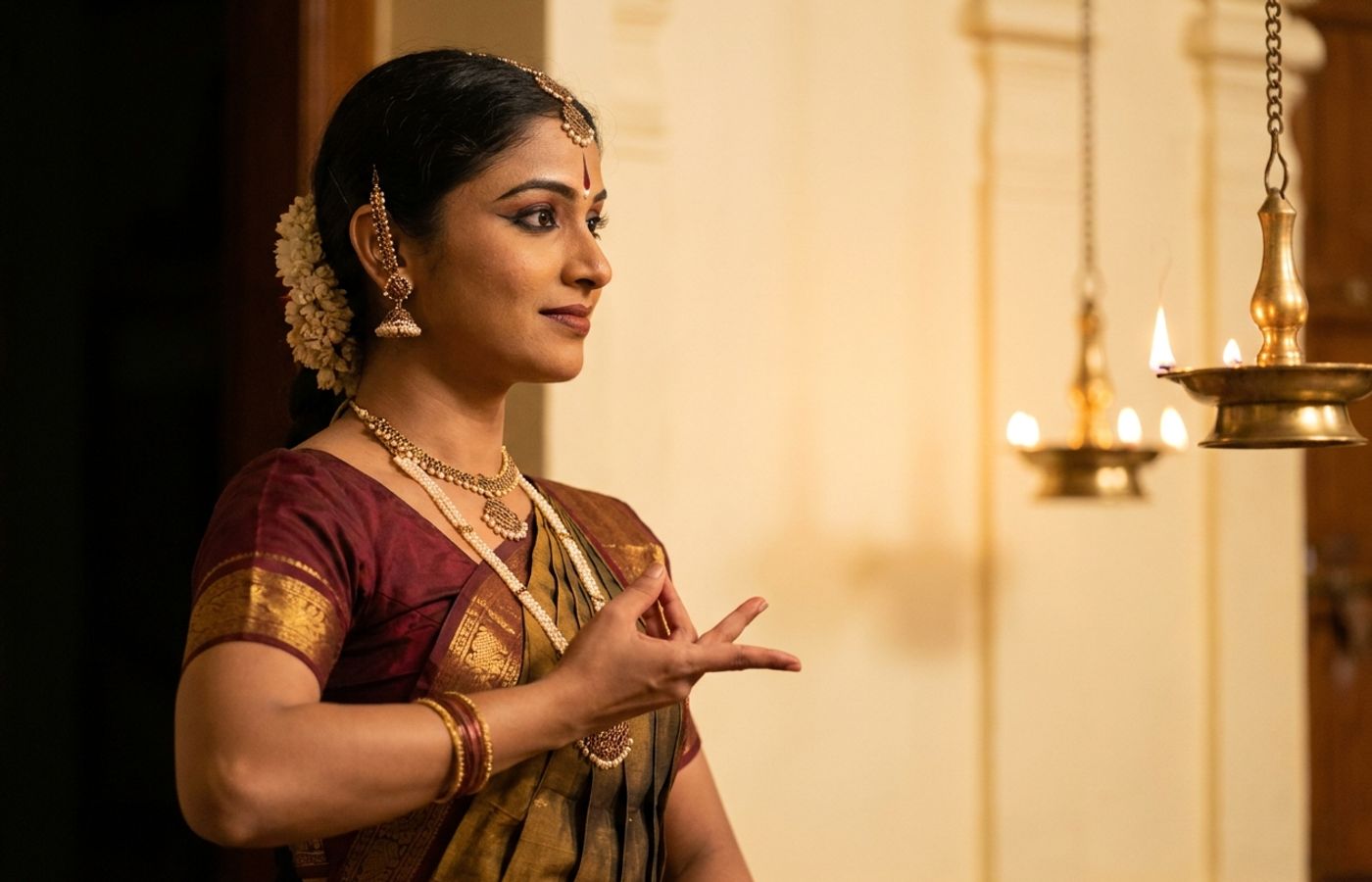
Search for hand mudras and you will find page after page about yoga, meditation, and wellness. Those traditions use hand positions as quiet, still gestures during breathing and seated practice. In Bharatanatyam, hand mudras do something different. They are a precise visual language, called hastas, that a dancer uses to tell stories, name objects, and express emotion in front of an audience. At Sridevi Dance Academy in Lexington, Kentucky, and in our online classes for families across the diaspora, we teach hand mudras as grammar first. This guide explains how that grammar works and how it differs from the mudras you may have met on a yoga mat.
The word mudra is Sanskrit and is commonly translated as a seal, sign, or gesture. In dance texts the more precise term for a hand gesture is hasta, which simply means hand. Both words appear in conversation, and students use them almost interchangeably. What matters is the system behind them: every hasta has a defined finger position, a name, a set of traditional meanings, and rules for how it moves.
Where hand mudras come from in Bharatanatyam
The codified hand gestures of Indian classical dance trace to the ancient treatises on performance. The Natya Shastra, attributed to the sage Bharata, lays out the foundations of theatre, dance, and music, including the role of hand gestures in abhinaya, the art of expression. Later texts, most importantly the Abhinaya Darpana attributed to Nandikeshvara, organised the hastas into the lists that Bharatanatyam teachers still use today.
These texts give each hasta a name and describe its form in detail. They also record the many ideas a single hasta can carry. This is why a student never memorises a hand shape in isolation. A guru teaches the shape, the name, the shloka that describes it, and the situations in which it is used. That layered learning is part of what the guru-shishya parampara protects.
Asamyukta and samyukta hastas: one hand and two
Bharatanatyam divides hand mudras into two broad families. Asamyukta hastas are single-hand gestures. They are traditionally taught as a set of twenty-eight, and they include shapes such as Pataka, Tripataka, Ardhapataka, Kartarimukha, Mayura, Alapadma, Shikhara, Mushti, and Hamsasya. Samyukta hastas are combined, double-hand gestures. They are commonly taught as a set of twenty-three, with Anjali, Kapota, Karkata, Swastika, and Dola among the names a beginner meets early.
The counts can vary slightly between lineages and texts, which is normal in a living tradition. What stays constant is the principle: a student first learns the individual shapes with clean finger placement, then learns to combine them into meaning. If you want to go deeper into either family, our student guides to the single-hand and double-hand hastas cover each one, and our posts on the mudras give a gurus-eye view of how they are taught.
How hand mudras differ from yoga mudras
The most useful way to compare the two is by purpose. A yoga mudra is typically held still. The practitioner positions the fingers, closes the eyes, and settles into the breath. The gesture is the practice. Gyan mudra, where the thumb and index finger meet, is a familiar example, and Anjali mudra, the palms pressed together at the heart, appears in both yoga and dance.
A dance hasta is rarely held for its own sake. It is a word in a sentence. The same Pataka that shows a flag, a forest, or a blessing in one phrase might mean a river or a wave in the next, depending on the movement that carries it, the direction of the gaze, and the expression on the face. The hasta moves through space, travels with the arm, and is timed to the tala, the rhythmic cycle of the piece. Where a yoga mudra invites stillness, a dance hasta takes part in motion and storytelling.
There is a respectful overlap, because both traditions grew from the same cultural soil and share some names and symbolism. But a dancer should not claim that practising hastas gives the same results as a meditation practice, or the reverse. They serve different goals, and an honest teacher keeps them distinct.
How a hasta gets its meaning in performance
When people ask why one mudra can mean several things, the answer is context. Meaning in Bharatanatyam is built from several layers working together. The hasta supplies the main shape. The arm movement and the angle of the hand place the idea in space. The griva bheda, shiro bheda, and drishti bheda, which are the neck, head, and eye movements, add direction and feeling. The face carries the bhava, the emotion that colours everything.
Consider a dancer showing a lotus. She may use Alapadma with the fingers fanned open and curved, held at a particular height, with a soft gaze following the hand. Change the gaze and the face and the same shape can suggest something else entirely. This is why a Bharatanatyam student trains hasta, eyes, neck, and expression together rather than treating the hand as a separate skill.
Learning hand mudras step by step
A sensible order for a beginner starts with the foundation stance, the aramandi, because a stable base keeps the upper body free and the hands relaxed. Next come the basic adavus, the rhythmic building blocks of nritta, or pure dance. Simple hasta positions are introduced alongside them so the hands learn to hold clean shapes while the feet keep time.
From there a student studies the single-hand hastas one at a time, learning the name, the form, and a few common meanings for each. Only then do the double-hand hastas and the longer abhinaya exercises appear. Hurrying this order is the most common reason that mudras look vague or stiff on stage. A guru will correct finger alignment patiently, because small errors in the wrist or the thumb change how the whole gesture reads.
Practice at home can be short and calm. Many families find that five to ten minutes a day, looking at the shape in a mirror and reciting the name, keeps the memory fresh between classes. Keep the hands warm, avoid forcing any finger past its comfortable range, and stop if anything hurts. Safe, gradual progression is part of how we teach, and the guru's scientific training shapes how carefully each position is introduced.
What parents and adult beginners should know
If your child is curious about hand mudras after seeing a performance, the good news is that they are among the more approachable parts of the art. Children as young as five or six can begin learning simple hastas, and the clear names and stories attached to them make memory easier. Adults returning to the art often find that hastas bring back a feeling of connection to stories they heard growing up.
Neither group needs prior experience. What helps is regular class attendance, patient practice, and a teacher who explains the meaning behind each gesture rather than only the shape. Our Lexington classes are small and warm, and our online classes follow the same curriculum so that families elsewhere in the United States can learn from the same guru without relocating.
Common mistakes with hand mudras
The first mistake is treating hastas as decoration. They are vocabulary, so a dancer who uses them without knowing their meaning will confuse the audience. The second is tension. Gripping the fingers makes the shape look rigid and tires the hand. The third is mixing up traditions, for example using a yoga hand position where a dance hasta belongs. The fourth is moving too quickly through the list without spending time on each shape.
A good guide helps you avoid all four by pairing every new hasta with its name, its textual description, and a short exercise that puts it in a phrase of movement. That is the approach we take in every batch.
Next steps
If hand mudras have drawn you to Bharatanatyam, the best way to begin is to see them taught in person or on a live video class. Explore Bharatanatyam classes to see how our curriculum is organised, or schedule a trial class to meet the guru and try your first hastas. You can also read more from the studio for further guides on the vocabulary of the art.
Common questions
What are hand mudras in Bharatanatyam?
Hand mudras, called hastas, are codified hand gestures used in Bharatanatyam to express objects, actions, and emotions. Each has a name, a defined finger position, and traditional meanings taught by the guru.
Are Bharatanatyam mudras the same as yoga mudras?
They share the word and some shapes, such as Anjali, but their purposes differ. Yoga mudras are usually held still during breath and meditation, while dance hastas move and combine with expression to tell a story.
How many hand mudras are there in Bharatanatyam?
They are commonly taught as twenty-eight single-hand (asamyukta) and twenty-three double-hand (samyukta) hastas. Exact counts can vary slightly between texts and lineages.
Can children learn hand mudras?
Yes. Children around five or six can start with simple hastas alongside basic stance and rhythm work. Short, regular practice and clear stories for each gesture make them easy to remember.
Do I need to know yoga before learning hastas?
No. Bharatanatyam hastas are taught from the beginning, and no yoga background is needed. A guru introduces each shape step by step.
Can I learn hand mudras online?
Yes. Sridevi Dance Academy offers online Bharatanatyam classes for families outside Lexington, Kentucky, following the same curriculum and giving live correction of hand positions.