
beginner
Bharatanatyam Meaning: Bhava, Raga, Tala and the Name Explained
Understand the Bharatanatyam meaning: bhava, raga, tala, the sage Bharata, and how the name reveals what a dancer truly learns. A guru's guide.
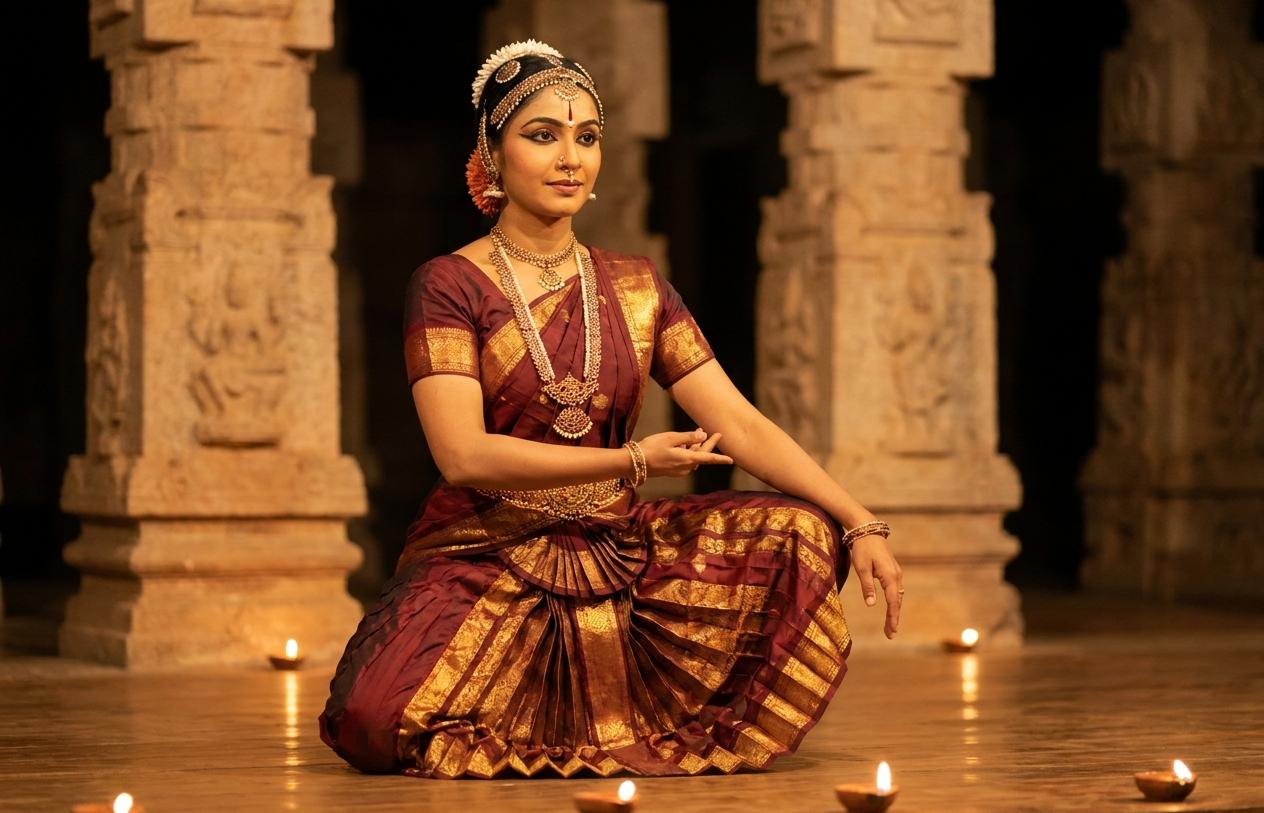
When families first search for the Bharatanatyam meaning, they usually expect a one line definition. The honest answer is richer than that. The word names a specific classical dance of South India, but it also carries a way of thinking about the art: that a dancer expresses feeling, sings the music with the body, and keeps time with the feet, all at once. At Sridevi Dance Academy in Lexington, Kentucky, and with our online students across the diaspora, we begin teaching with this meaning, because a student who understands the name understands what the training is for.
This guide walks through the Bharatanatyam meaning from several angles: the words that make up the name, the popular bha, ra, ta explanation, the sage Bharata and the Natya Shastra, and what the name tells us about nritta, nritya, and abhinaya. It is written for parents, adult beginners, and students who want to know what they are really learning.
The Bharatanatyam meaning in plain words
Bharatanatyam is a classical dance form that comes from Tamil Nadu in South India. The name is usually split into two parts. Natyam is a Sanskrit word for dance drama, which is a useful clue already. In the Indian tradition, natya is not only movement. It includes story, expression, music, and the stage itself. The first part, Bharata, is explained in more than one way, and a careful teacher shares both explanations instead of choosing one and hiding the other.
So at the simplest level, Bharatanatyam means the dance drama connected to Bharata. At a deeper level, it points to a complete performing art in which body, face, voice of the music, and rhythm work as one.
Bha, ra, ta: bhava, raga, tala
The most loved explanation among dancers breaks the word Bharata into three syllables. Bha stands for bhava, the emotion and inner feeling. Ra stands for raga, the melodic framework of the music. Ta stands for tala, the rhythmic cycle that holds the performance together. Natyam, the dance drama, completes the word.
This reading is a teaching device handed down in dance circles, and many scholars note that it is a later, symbolic interpretation and not the original source of the name. We share it with students because it is useful, not because it is the only truth. It describes exactly what a dancer must master. Feeling without rhythm is loose. Rhythm without feeling is mechanical. Melody without either is only a recording. Bharatanatyam asks the dancer to hold all three.
In our classroom this shows up early. A beginner learning her first adavus is already counting tala with the hands on the thigh. By the time she learns a simple padam, she is expected to listen for the raga and let bhava rise from the music. The bha, ra, ta idea is not a slogan on a wall. It is a daily practice.
Bharata, the Natya Shastra, and the other reading of the name
The second explanation connects the name to the sage Bharata, traditionally credited as the author of the Natya Shastra. This Sanskrit treatise on performing arts discusses dance, drama, music, stage design, and the theory of rasa, the aesthetic flavors a performance is meant to awaken. Its exact date is debated by scholars, so we say only that it is an ancient and foundational text for Indian performing arts. If you would like to go deeper, our guide to the Natya Shastra for Bharatanatyam students is a good next read.
Under this reading, Bharatanatyam is the dance that honors the Natya Shastra tradition. The treatise gives the art its vocabulary for hand gestures, movements of the head, neck, and eyes, and the nine rasas. When a student learns the hastas, the griva bheda, the shiro bheda, and the drishti bheda, she is working with ideas that this tradition helped to shape.
Both readings live comfortably together. One is about the sage and the textual lineage. The other is about the three living elements of performance. A dancer who knows both carries the history and the craft.
From sadir to Bharatanatyam: how the name came to be used
Another part of the Bharatanatyam meaning is historical. The art that we now call Bharatanatyam was practiced in temples and courts of Tamil Nadu for generations under other names, such as sadir or dasiattam, and was carried by devadasi communities and by hereditary teachers known as nattuvanars. The Thanjavur region and the court musicians and dance masters there, often remembered as the Tanjore Quartet, helped to organize the repertoire that became the margam we still follow.
In the twentieth century the art went through a period of revival and renaming, and the name Bharatanatyam became the standard way to refer to it. This matters because it reminds us that the name is a statement of identity. It places the dance within the larger framework of classical Indian performing arts, and it asks students and audiences to approach it with the seriousness it deserves. We prefer to tell this history carefully and without drama, since students deserve accuracy about where their art comes from.
What the name tells you about nritta, nritya, and abhinaya
Because natyam means dance drama, the name already hints at the three layers of Bharatanatyam. Nritta is pure dance: rhythmic patterns built from adavus, performed in aramandi, with attention to line, symmetry, and tala. Nritya combines that movement with expression, so that the dance carries meaning. Abhinaya is the art of expression through hastas, facial movement, and posture, used to tell a story or portray a feeling.
A complete Bharatanatyam performance moves between these layers. An alarippu is mostly nritta, offering the dancer and the gods a gentle opening. A varnam is the heart of the margam, where nritta and nritya meet in a long piece that tests stamina and expression. A padam is largely abhinaya, where a single line of poetry can be explored for several minutes. A tillana closes the evening with joyful rhythm and graceful shapes. Each of these is a different answer to the same question that the name raises: how do bhava, raga, and tala come alive in one body?
Why the meaning matters for a new student
Parents often ask whether children need to know all this at the start. The answer is that they do not need to memorize it, but they should hear it. A child who understands that her hand gesture is a word in a language, and that her foot pattern sits inside a rhythmic cycle, practices with more care. She also corrects herself more readily, because she knows what the movement is supposed to say.
For adult beginners and those returning to their roots, the meaning gives context. Many adults arrive saying they want to reconnect with something their grandmothers knew. Learning the name and its layers is a gentle way to begin. It turns Bharatanatyam from a set of steps into a living tradition that they are entering with respect.
In a guru-shishya parampara, meaning is not separated from technique. When we teach the posture of aramandi, we explain why the knees turn out and how to protect them. When we teach a hasta, we also teach what it can signify and where it appears in a piece. Our founder brings the same precision from her scientific profession into the studio, so that every movement is named, measured, and understood.
How to explore the Bharatanatyam meaning further
If this article raised questions, there are several natural next steps. You can read about the history of the form, the structure of the margam, or the hand gestures in our other guides. You can also watch a live class or ask a teacher to show you how bhava, raga, and tala appear in a single short piece.
For families in Lexington, Kentucky, we welcome you to see a class in person. For families elsewhere in the United States and around the world, our online classes follow the same curriculum and the same standards. Either way, the best way to understand the Bharatanatyam meaning is to experience it with a guru who can show you, not only tell you.
Common questions
What is the meaning of Bharatanatyam?
Bharatanatyam is a classical dance form from Tamil Nadu. Natyam means dance drama, and Bharata refers either to the sage traditionally credited with the Natya Shastra or, in the popular teaching reading, to bhava, raga, and tala.
What does bha, ra, ta stand for in Bharatanatyam?
In the popular dancer's explanation, bha is bhava (emotion), ra is raga (melody), and ta is tala (rhythm). Scholars see this as a symbolic teaching reading and not the original source of the name, but it describes the skills a dancer must master.
Who was Bharata in the name Bharatanatyam?
Bharata is the sage traditionally credited as the author of the Natya Shastra, an ancient Sanskrit treatise on performing arts. Its exact date is debated, but it is foundational for Indian classical dance and drama.
Was Bharatanatyam always called by this name?
No. The art was practiced in temples and courts of Tamil Nadu under names such as sadir or dasiattam. The name Bharatanatyam became the standard term during the twentieth century revival of the art.
Do children need to learn the meaning of Bharatanatyam to start classes?
They do not need to memorize it, but hearing it early helps. Children who understand that hastas are a language and that footwork sits inside a tala practice with more care and attention.
Can I learn Bharatanatyam online if I do not live near Lexington, Kentucky?
Yes. Sridevi Dance Academy teaches students online across the diaspora with the same curriculum and standards as in person classes, guided by one guru in the guru-shishya parampara. A trial class is a good first step.